Notifications

8 minutes, 31 seconds
-29 Views 0 Comments 0 Likes 0 Reviews
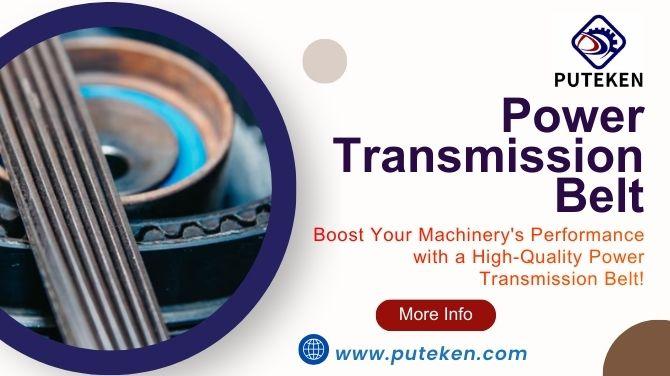
In the competitive world of industrial machinery and automation, performance and reliability are not just desired—they're demanded. Whether you're running a high-speed production line, operating complex CNC machinery, or automating heavy-duty equipment, every component must work harmoniously to ensure smooth, uninterrupted operations. Among these essential components, the Power Transmission Belt stands out as a critical force multiplier—linking power sources to driven components and ensuring the efficient transfer of motion.
Though often underestimated, the Power Transmission Belt is a core element of nearly every mechanical system across manufacturing, agriculture, automotive, mining, textile, and countless other sectors. When designed and maintained correctly, this simple belt enables your machinery to operate at optimum efficiency, extends equipment life, reduces maintenance frequency, and lowers energy consumption. Conversely, a poor-quality or incorrectly selected belt can lead to slippage, vibration, system inefficiencies, and costly breakdowns.
At Shanghai Puteken Transmission System Co., Ltd., we understand that not all transmission belts are created equal. With decades of expertise in belt manufacturing and tailored industrial solutions, we supply high-quality Power Transmission Belts engineered to meet a spectrum of operational needs—from light-duty drives in paper processing lines to heavy-duty power transfer in mining and construction machinery.
A Power Transmission Belt is a flexible belt used to transmit mechanical power between two or more rotating shafts, typically via pulleys in a drive system. Unlike conveyor belts, which are designed to transport goods or materials, transmission belts transfer torque and motion—making them essential for powering machines and equipment.
There are several types of power transmission belts, each suitable for specific applications:
Types include:
Each belt type offers unique strengths in terms of speed, torque capacity, flexibility, and resistance to wear, making proper selection a key factor in machinery performance.
A high-quality Power Transmission Belt directly affects how efficiently your machinery operates. Here's how it makes a difference:
At Shanghai Puteken Transmission System Co., Ltd., we manufacture and supply Power Transmission Belts made with precision-engineered materials and advanced production processes to ensure maximum durability and performance.
What Sets Our Belts Apart?
We understand that off-the-shelf solutions don't always fit complex industrial requirements—so we offer tailor-made transmission belts to solve your specific power transfer challenges.
Choosing the Right Power Transmission Belt
Selecting the right Power Transmission Belt begins with understanding your machinery, operational environment, and performance goals.
Key Selection Criteria:
1. Belt Type
2. Load Requirements
3. Speed Range
4. Center Distance Between Shafts
5. Environmental Conditions
6. Space Constraints
Our technical team at Shanghai Puteken can assist you in specifying the right belt to avoid overdesign, reduce energy usage, and maximize mechanical compatibility.
To get the most from your Power Transmission Belt, it’s essential to implement a proper maintenance routine.
Preventive Maintenance Checklist:
Avoiding belt neglect can save thousands in unplanned downtime and mechanical repair. When in doubt, consult with Shanghai Puteken’s support team for quick belt diagnostics and replacement recommendations.
Every piece of machinery is only as strong as its weakest link, and in many industrial applications, the Power Transmission Belt may very well be that link. But when chosen and maintained correctly, it becomes a performance powerhouse—driving your equipment faster, smoother, and more reliably than ever before.
A high-quality Power Transmission Belt reduces energy loss, minimizes downtime, and supports your operation’s long-term sustainability. At Shanghai Puteken Transmission System Co., Ltd., we pride ourselves on delivering industry-leading transmission belts that match your performance and reliability needs.
Q1: How do I know when to replace a Power Transmission Belt?
A: Signs include cracking, excessive elongation, noise during operation, or visible wear on the sidewalls. Routine inspections and tracking operating hours are essential.
Q2: What's the difference between a timing belt and a V-belt?
A: A timing belt has teeth for synchronizing movement without slippage—ideal for precise motion applications. A V-belt relies on friction and is better for high-load scenarios with slight slip tolerance.
Q3: Can your belts operate in high-temperature environments?
A: Yes. We offer heat-resistant Power Transmission Belts specifically designed to function in environments reaching up to 150°C (or more depending on materials used).
Q4: How can I improve lifespan on a frequently replaced belt?
A: Switch to a reinforced or higher-grade material, verify tension/alignment, avoid oil exposure, and reduce operating speeds if possible. Our team can recommend optimized designs.
Q5: Do you offer customized belts for OEM applications?
A: Absolutely. We offer full customization—from size, material, and reinforcement type to teeth pitch and joint method—for equipment manufacturers and industrial users worldwide.


