Notifications

7 minutes, 33 seconds
-15 Views 0 Comments 0 Likes 0 Reviews
India Alcohol Market to Reach USD 312.4 Billion by 2036 as Premiumization Reshapes Industry Dynamics
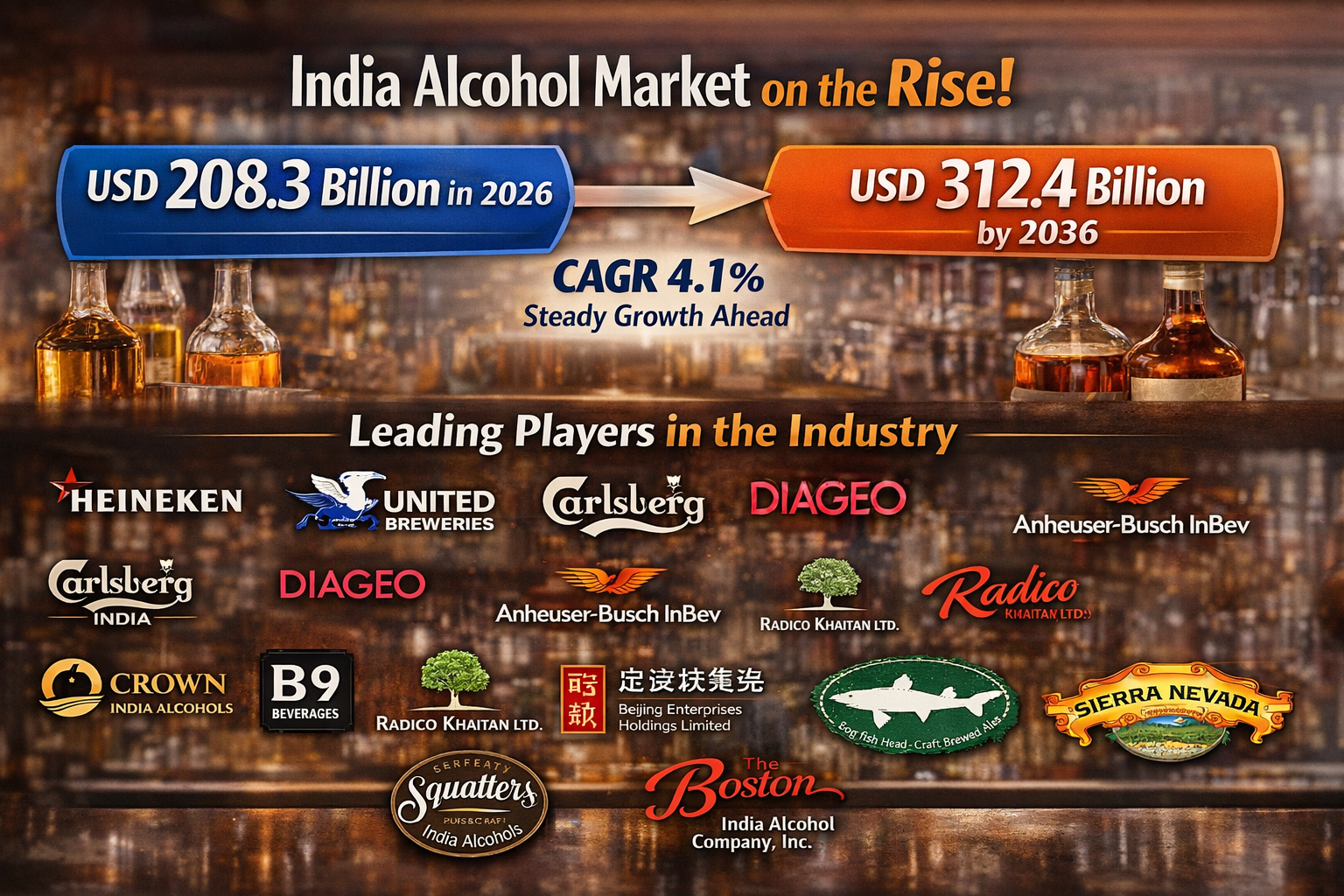
India’s alcohol industry is entering a decisive decade. Valued at USD 208.3 Billion in 2026, the market is projected to expand to USD 312.4 Billion by 2036, registering a steady 4.1% CAGR, according to Future Market Insights.
But the growth story unfolding across the country is not merely about rising consumption. It is about structural transformation — a shift from volume-driven expansion to value-led premiumization.
The Rise of Value Over Volume
For years, India’s alcohol market was defined by mass consumption and price-sensitive demand. That equation is changing. Today’s consumers are increasingly trading up.
A clear signal of this transition came from the Confederation of Indian Industry (CII) in its 2024 annual review. The report observed that India’s spirits consumption grew at nearly twice the rate of volume growth, underscoring a powerful value-over-volume shift across the sector.
This trend reflects a broader behavioral evolution:
Premiumization is no longer confined to metropolitan pockets. It is expanding across Tier II and Tier III cities, driven by rising disposable incomes, exposure to global brands, and evolving lifestyle preferences.
Premium Spirits Take Center Stage
The migration toward high-end products is reshaping category hierarchies. Single malts, craft gins, and heritage-branded spirits are capturing disproportionate growth relative to traditional mass-market labels.
This movement reflects three interconnected factors:
In effect, premium spirits are becoming symbols of identity and sophistication, rather than simply beverages.
Infrastructure Investments Signal Long-Term Confidence
The premiumization wave is not just influencing retail shelves — it is reshaping capital allocation strategies across the value chain.
To sustain the shift toward higher-value offerings, distillers are investing in:
Unlike mass-market products, premium spirits require longer production cycles, stricter quality control, and curated distribution strategies. These investments signal long-term confidence in sustained value growth rather than short-term sales spikes.
Structural Drivers Behind the 4.1% CAGR
The projected growth from USD 208.3 Billion in 2026 to USD 312.4 Billion by 2036 is not speculative. It rests on structural underpinnings.
Key growth catalysts include:
What makes this trajectory particularly stable is its reliance on value growth rather than pure volume expansion. That distinction strengthens pricing resilience and supports healthier margins across the ecosystem.
👉 Unlock In-Depth Market Intelligence — Access the Full Report Now
Regulatory Realignment: From Fragmentation to Harmonization
While demand dynamics are shifting, policy structures are also evolving.
India’s alcohol market has historically operated under state-level excise fragmentation. Each state enforces distinct taxation, licensing, and distribution frameworks, creating operational complexity for manufacturers.
However, early discussions around policy harmonization under the Goods and Services Tax (GST) framework indicate a gradual move toward regulatory alignment.
If realized, such harmonization could:
At the same time, this evolving landscape forces manufacturers to recalibrate pricing architectures and logistics models to remain competitive.
Pricing Architecture Under Pressure
As regulatory discussions progress, alcohol producers must navigate dual pressures:
Premiumization supports higher margins, but inconsistent state-level excise duties can compress profitability. Manufacturers are therefore re-evaluating interstate supply routes, pricing tiers, and distribution partnerships.
Strategic agility in pricing and logistics will determine which players capture the largest share of the projected USD 312.4 Billion opportunity.
A Decade of Strategic Repositioning
India’s alcohol market is not simply expanding — it is maturing.
The structural shift toward value-led consumption is redefining competition. Success in this environment requires more than production scale. It demands:
With a projected CAGR of 4.1% through 2036, growth will be steady rather than explosive. Yet, the quality of growth — anchored in premiumization — makes the outlook structurally robust.
Conclusion
India’s alcohol market is entering a value-centric era. The projected rise from USD 208.3 Billion in 2026 to USD 312.4 Billion by 2036 reflects more than incremental expansion. It signals a strategic inflection point.
Consumers are upgrading. Brands are repositioning. Infrastructure is evolving. Regulatory conversations are advancing.
In this environment, the winners will not be those chasing volume alone, but those aligning with the premiumization wave reshaping India’s spirits landscape — one refined bottle at a time.
𝗪𝗵𝘆 𝗙𝗠𝗜: 𝗵𝘁𝘁𝗽𝘀://𝘄𝘄𝘄.𝗳𝘂𝘁𝘂𝗿𝗲𝗺𝗮𝗿𝗸𝗲𝘁𝗶𝗻𝘀𝗶𝗴𝗵𝘁𝘀.𝗰𝗼𝗺/𝘄𝗵𝘆-𝗳𝗺𝗶
About Future Market Insights (FMI)
Future Market Insights, Inc. (FMI) is an ESOMAR-certified, ISO 9001:2015 market research and consulting organization, trusted by Fortune 500 clients and global enterprises. With operations in the U.S., UK, India, and Dubai, FMI provides data-backed insights and strategic intelligence across 30+ industries and 1200 markets worldwide.
Contact Us:
Future Market Insights Inc.
Christiana Corporate, 200 Continental Drive,
Suite 401, Newark, Delaware - 19713, USA
T: +1-347-918-3531
For Sales Enquiries: sales@futuremarketinsights.com
India Alcohol Market Share India Alcohol Market Overview India Alcohol Market Forecast India Alcohol Market Trends


