Notifications

11 minutes, 45 seconds
-576 Views 0 Comments 0 Likes 0 Reviews
Compare QLED vs. OLED for long-term value in Pakistan. Discover durability, performance, and price insights for your next TV at Lahore Centre.
In the competitive landscape of 2026, the choice between a QLED TV and an OLED TV represents one of the most significant dilemmas for consumers seeking a premium viewing experience. Both technologies offer stunning visuals, but their underlying principles and long-term implications, especially within the specific context of Pakistani homes, can vary dramatically. For many, a television isn't just a gadget; it's a significant investment, expected to deliver flawless performance for years. Understanding which technology offers superior long-term value involves looking beyond initial picture quality and delving into factors like durability, brightness, power efficiency, and price-to-performance ratio. At Lahore Centre, we guide our customers through these nuances, ensuring they make an informed decision that aligns with their lifestyle and budget.
At a fundamental level, QLED and OLED TVs operate on distinct principles. OLED (Organic Light-Emitting Diode) pixels are self-emissive; each tiny pixel generates its own light. This allows for "perfect blacks" because individual pixels can be turned completely off, creating infinite contrast. Conversely, QLED (Quantum Dot Light-Emitting Diode) technology enhances a traditional LED-backlit LCD panel with a layer of Quantum Dots. These nanocrystals produce incredibly pure and vibrant colors when illuminated by the backlight. While QLED relies on a backlight, advanced local dimming zones and Quantum Dots allow it to achieve exceptional contrast and brightness, pushing the boundaries of what an LCD can do.
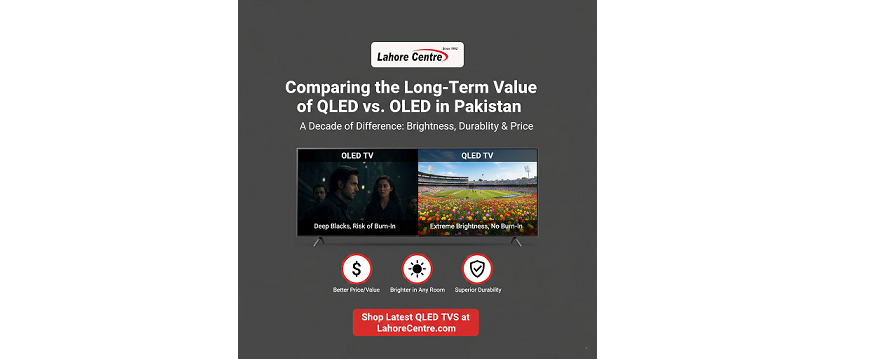
One of the most immediate and practical considerations for Pakistani households is ambient light. Living spaces are often well-lit, either by abundant natural sunlight or bright indoor lighting. In such environments, the superior brightness of QLED becomes a significant advantage. A high-end Samsung QLED TV can achieve peak brightness levels ranging from 1,500 to 4,000 nits, allowing it to cut through glare and maintain vibrant, punchy HDR (High Dynamic Range) visuals even during the sunniest parts of the day. OLED TVs, while excellent in dark rooms, typically max out at 800-1,000 nits, which can make them appear dimmer and their colors less impactful in brightly lit conditions. For families who watch TV throughout the day, QLED offers a consistently brilliant picture regardless of external lighting.
Perhaps the most critical long-term value differentiator in the Pakistani market is durability, particularly concerning "burn-in." OLED panels, being organic, are susceptible to permanent image retention if static elements (like news tickers, channel logos, or video game HUDs) are displayed for prolonged periods. Given the common usage patterns in Pakistani homes, where a single news channel or a sports broadcast might run for many hours, this poses a genuine risk. In contrast, LG QLED models, like all QLED TVs, use inorganic Quantum Dots and are immune to burn-in. This makes QLED a much safer investment for heavy users or those who prefer set-it-and-forget-it reliability. For a TV that is expected to last 7-10 years, QLED offers unparalleled peace of mind.
While the initial price difference between QLED and OLED has narrowed in 2026, QLED typically remains the more budget-friendly option, especially as screen sizes increase. For instance, a 65-inch TCL QLED might offer comparable features to an OLED at a significantly lower cost. This allows consumers to either save money or invest in a larger screen size for the same budget. When considering long-term value, this initial saving, combined with the proven durability against burn-in, means that QLED often delivers a better "cost per year" of ownership. It makes premium display technology accessible without the associated premium long-term risks.
Color volume is another area where QLED consistently excels. This metric measures a display's ability to reproduce a wide range of colors at varying levels of brightness. Thanks to Quantum Dots, a Haier QLED TV can achieve 100% color volume, meaning colors remain vibrant and saturated even when the screen is at its brightest. OLED, while having excellent color accuracy at lower brightness, can sometimes show a slight desaturation in extremely bright highlights due to its self-emissive nature. For HDR content, which relies heavily on bright, punchy colors, QLED’s superior color volume often results in a more dynamic and impactful viewing experience that fully leverages the extended color spaces of modern content.
With rising energy costs, power consumption is an increasingly important factor in long-term value. While both technologies have become more efficient, OLED, due to each pixel generating light, can sometimes consume more power when displaying very bright, all-white scenes. QLED, with its LED backlight, tends to have a more stable power draw. Manufacturers like Haier are continuously optimizing their QLED panels for energy efficiency, ensuring that your home entertainment doesn't become a hidden drain on your electricity bill over its lifetime. This contributes to the overall economic advantage of QLED in the long run.
For the rapidly growing community of Pakistani gamers, both QLED and OLED offer excellent performance. OLED boasts near-instantaneous pixel response times, leading to virtually no motion blur. However, the latest QLED TVs have significantly closed this gap, offering refresh rates up to 144Hz, low input lag, and support for features like Variable Refresh Rate (VRR) and Auto Low Latency Mode (ALLM) through HDMI 2.1. The brighter image of QLED can make HDR games look incredibly immersive, especially in a well-lit gaming room. While OLED technically holds a slight edge in pure response time, QLED provides a stellar gaming experience with the added benefit of burn-in resistance, making it a safer long-term choice for dedicated gamers.
Both QLED and OLED TVs from major brands come with advanced smart platforms like Tizen (Samsung), WebOS (LG), or Google TV (TCL, Haier). The long-term value here depends on the manufacturer's commitment to software updates and platform support. All major brands generally offer several years of updates, ensuring your apps remain compatible and the interface stays responsive. However, the hardware behind these smart features also matters. QLED TVs often integrate powerful processors to handle AI upscaling and complex smart functionalities, which can contribute to the overall longevity of the "smart" experience, preventing it from feeling outdated in a few years.
In the Pakistani market of 2026, when all factors are weighed—from initial cost and ambient light performance to long-term durability and resistance to burn-in—QLED TVs emerge as the more pragmatic premium choice. While OLED delivers an undeniable cinematic experience in a controlled environment, QLED offers a brilliant, robust, and reliable viewing solution that caters to the diverse needs of an active family home. It is a technology that doesn't ask you to compromise on brightness for color, or on durability for depth. For those seeking a smart investment that will continue to deliver stunning visuals for years to come, a QLED TV from Lahore Centre represents the optimal balance of cutting-edge performance and enduring value.
Q1: Which TV is better for watching movies in a dark room, QLED or OLED? For movies in a perfectly dark room, OLED often has a slight edge due to its perfect blacks and infinite contrast, creating a truly cinematic experience.
Q2: Is burn-in a real problem with OLED TVs? While manufacturers have implemented technologies to mitigate it, burn-in remains a potential risk with OLED TVs, especially with prolonged display of static content. QLED TVs are completely immune to burn-in.
Q3: Can QLED TVs get as bright as OLED TVs? QLED TVs can get significantly brighter than OLED TVs. This is a major advantage in brightly lit rooms, where QLEDs can maintain image clarity and vibrant colors much more effectively.
Q4: Which technology is generally more expensive, QLED or OLED? Generally, OLED TVs tend to be more expensive than comparable QLED TVs, especially as screen sizes increase. QLED often offers a better price-to-performance ratio for most consumers.
Q5: What is "Color Volume" and why is it important for QLED? Color Volume measures a TV's ability to display a wide range of colors at all brightness levels. QLED's Quantum Dots excel here, ensuring colors remain vibrant and accurate even in the brightest scenes, which is crucial for impactful HDR content.