Notifications

5 minutes, 43 seconds
-76 Views 0 Comments 0 Likes 0 Reviews
Land disputes, delayed property mutations, and missing registry documents are among the most common problems faced by citizens of Uttarakhand. Thousands of people every year struggle to get basic land-related information from government offices. The good news is that the Right to Information Act, 2005 gives you a clear legal path to get this information without running from office to office. This guide how to file RTI in Uttarakhand specifically to resolve land record issues in the state in 2026.
Uttarakhand is a state where land ownership disputes are extremely common. The hilly terrain, joint family property divisions, government acquisition of forest and border land, and frequent migration of residents have created widespread confusion in land records across districts like Dehradun, Haridwar, Pauri, Tehri, Nainital, and Pithoragarh.
Many citizens find that their property mutation is pending for months, their land records show incorrect ownership details, or their registry documents are missing from government records. In all such cases, the most effective first step is to file RTI in Uttarakhand with the concerned revenue department.
The Revenue Department of Uttarakhand is the primary authority responsible for maintaining land records, khatauni, khasra numbers, property mutation, and registry-related documents. At the district level, the Tehsildar and Sub-Divisional Magistrate offices are the key public authorities you need to approach.
Under Section 2(h) of the RTI Act, all these revenue offices qualify as public authorities and are fully covered under the scope of the law. This means you have every legal right to seek land-related information from them through a formal RTI application.
When you file RTI in Uttarakhand for land-related matters, you can request a wide range of information. You can ask for the current ownership status of a specific plot or agricultural land, the details of any pending or completed mutation application, copies of land registry documents, details of government land acquisition in your area, the status of a land dispute filed with the revenue court, and the record of rights or khatauni for a specific khasra number.
Always frame your questions with specific details such as plot numbers, khasra numbers, district names, and the financial year in question to maximize the chances of receiving a complete and useful response.
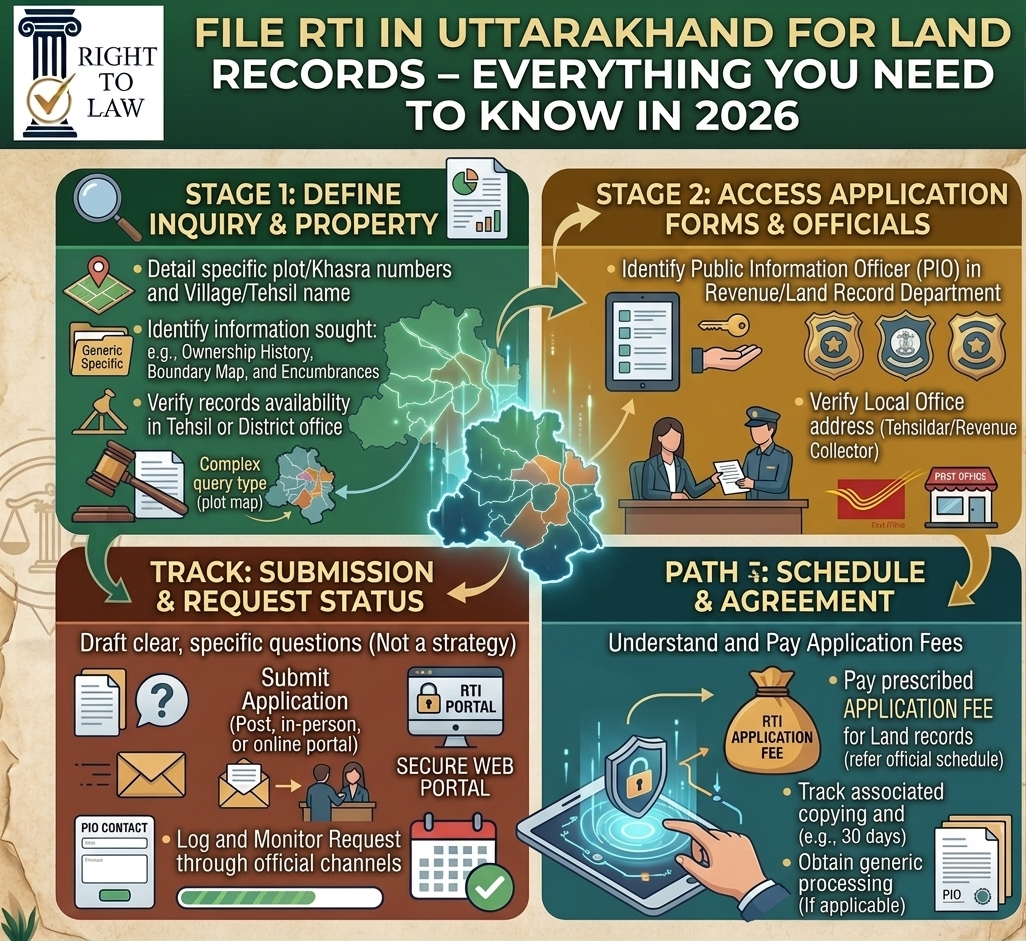
Start by identifying the exact Tehsil or Sub-Division office that maintains the land records for your specific property. Write your application in simple Hindi or English, clearly mentioning the khasra number, khata number, village name, and district. State each information request as a separate numbered point.
Pay the application fee of Rs. 10 through an Indian Postal Order or Demand Draft in favour of the Public Information Officer of the concerned revenue office. Attach a copy of the payment receipt along with your application.
Submit the application by registered post to the SPIO of the relevant Tehsil office, or use the official Uttarakhand RTI portal for online submission. Keep a copy of everything you send for your records.
The Public Information Officer is legally required to respond to your application within 30 days of receipt. If you do not receive a response within this period or if the response is incomplete or unsatisfactory, you can file a First Appeal with the First Appellate Authority at the district level. If that too fails, escalate to the Uttarakhand State Information Commission in Dehradun as a Second Appeal.
Land-related disputes should not leave you helpless. When government offices are slow or unresponsive, the RTI Act is the fastest and most affordable legal tool at your disposal. Whether it is a property mutation delay or a missing registry document, you can file RTI in Uttarakhand and legally compel the concerned revenue authority to give you the information you need. Draft your application carefully, submit it to the right department, and follow up through the appeal process if required. Your land rights deserve protection — and RTI is how you enforce them.


