Notifications

12 minutes, 8 seconds
-34 Views 0 Comments 0 Likes 0 Reviews
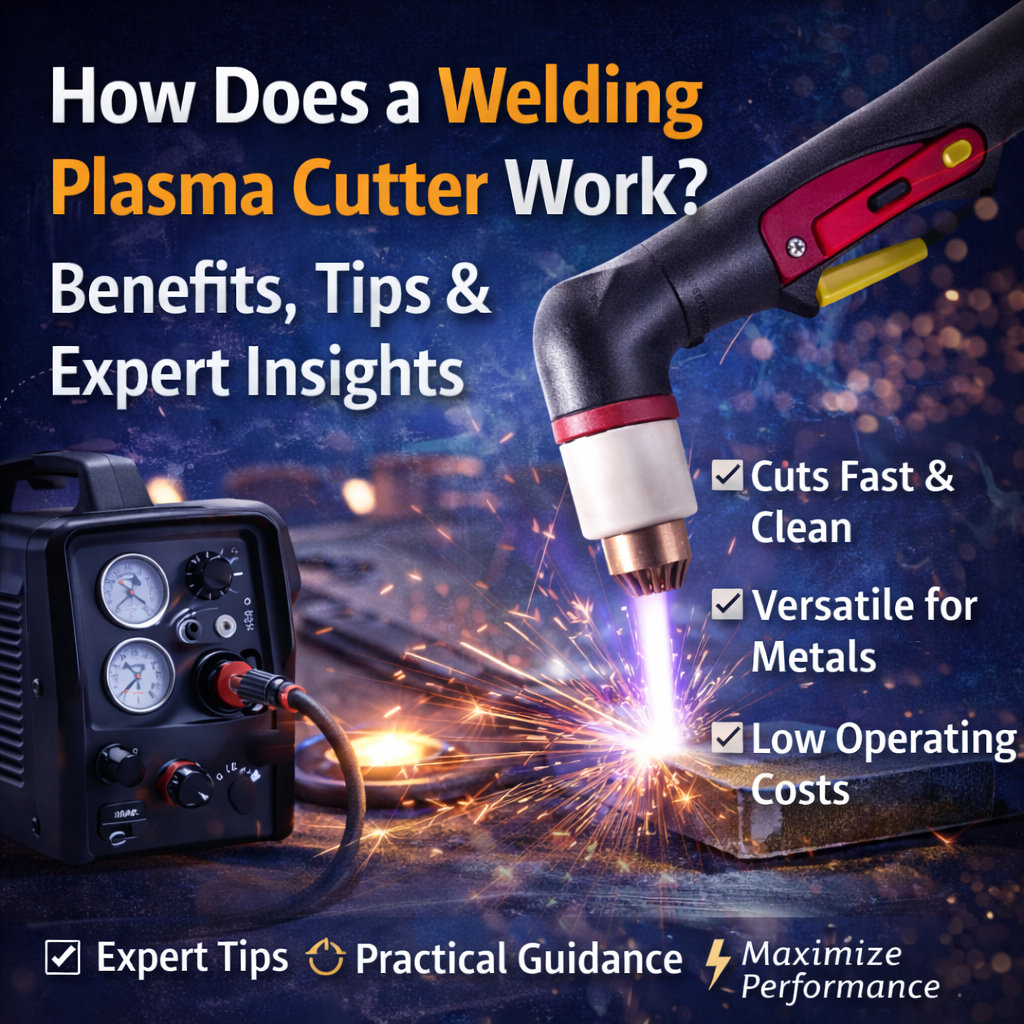
Metalwork has developed a step further than grinders and saws. One of the most frequent questions of beginners in fabrication, mechanics, and DIY construction is how a welding plasma cutter works. A plasma cutter is an electrically powered machine that is used to cut through metal in a fast and precise manner. This tutorial explains the principle of operation, benefits, tips by the professionals and practical examples in an easy and simple way.
A plasma cutter is a device that cuts conductive metals with a jet of ionized gas termed plasma at a high temperature. Plasma cutting cuts metals as opposed to welding, which fuses them.
Metals you can cut:
Mild steel
Stainless steel
Aluminum
Brass and copper
Galvanized metals
Think of plasma like a focused lightning bolt controlled through a torch. It melts the metal while compressed air blows the molten material away.
Formation of an electric arc between the nozzle and electrode.
The torch has compressed air flowing through it.
The gas is ionized and transforms into plasma.
The plasma arc moves to the metal surface.
A clean cut is produced by blowing out molten metal.
This is done within seconds, which is why plasma cutting is quicker compared to the traditional ones.
Power supply – generates electrical energy
Torch – directs the plasma stream
Electrode & nozzle – shape the arc
Air compressor – provides cutting gas
Ground clamp – completes the circuit
Faster than oxy-fuel
More affordable than laser
Works on more metals than mechanical saws
Produces narrow, precise kerf
Plasma cutting is extremely quick compared with other metal-cutting methods. The arc of the plasma will melt the metal immediately thus allowing the torch to move very fast over the surface. This will save much time particularly when a number of parts have to be cut. Reduced cutting time implies that an increased amount of work can be completed on a single day.
Plasma cutters produce clean and smooth cuts. The rim of the metal is normally not required to be heavily ground or polished. This saves on additional post reduction. Clean edges also allow parts to fit together more easily when welding or putting parts together.
Plasma cutting concentrates the heat at a tiny point. The rest of the metal does not become too hot. This helps to avoid bending of the metal or its loss of strength. Due to this reason, the form of the material remains correct.
A plasma cutter is able to cut thin sheets and even thick plates. You do not require different machines for different metal sizes. This makes the tool suitable for most types of jobs, both small and heavy fabrication.
Plasma cutters are mostly small and portable. They are applicable in workshops, garages or on job sites. All you need to begin cutting is electricity and air. This is because the tool is mobile friendly.
Plasma cutting is not expensive to operate. It consumes low electricity and compressed air mainly. The consumable components are cheap and long lasting. This assists the businesses in being cost-effective in all projects.
Plasma cutters can be divided in two ways: by how they are used and by how they start the arc. Knowing these types helps you pick the right machine for your job.
Handheld plasma cutters are small and used as power tools. The user will have the torch and move it manually to cut the metal. They suit home garages, repairs, and automotive jobs and little workshops. These machines are user friendly and good in straight or curved cuts.
CNC cutters are computer-controlled machines which cut using plasma. The torch also goes on by itself by design file. They are applied in factories and large stores to produce numerous components having identical forms. The production provided by CNC systems is very accurate and fast.
Pilot arc start refers to a small arc that is drawn within the torch before coming in contact with the metal. This assists the cutter to initiate without any difficulty on rusted or painted surfaces. It is dependable and widespread in contemporary machines.
Blowback start – this is when air pressure within the torch is used to make the arc. It does not operate on high frequency signals hence it is safe for electronics. Such torches are long-lasting and require less maintenance.
High frequency start involves the use of a electrical spark to initiate the arc. It begins with a smooth start, and it is capable of affecting other electronic devices nearby. This was employed more in older plasma cutters.
To obtain clean plasma cuts, the correct amperage for the metal thickness must be applied and the distance between the torch and the metal should always be a small constant distance. The arc functions best in dry, clean air so a good air filter is of assistance. The old nozzles and electrodes need to be changed on time as the cut ends up becoming rough and bumpy with the old parts.
It is also very important to move the torch steadily. Going too fast results in the metal not cutting all the way through and going too slow results in a lot of additional metal being deposited on the edge. Removing rust or paint prior to cutting is also beneficial to the outcome. Plasma cutting is similar to drawing a straight line with a marker that is made on a smooth and balanced movement.
Numerous issues occur during plasma cutting due to some typical mistakes. The incorrect air pressure may result in the arc being weak and rough edges. When the torch is dragged on the metal, the cut is also not even and the nozzle is damaged. Worn electrodes reduce cutting power and need to be replaced in time. Another problem that causes the arc to be unstable and difficult to control is poor grounding.
The plasma arc may be blocked by cutting over dirty or painted surfaces and gives messy results. These minor details can be perceived as easy, yet they have an enormous impact on the final cut. The prevention of these mistakes will enhance the quality of cuts immediately and will cause the machine to run smoothly.
The first thing during the use of a plasma cutter should be safety. The operator should wear gloves, face shield and fire resistant clothing to protect from sparks and hot metal. Proper ventilation is required since the use of plasma cutting generates fumes that should not be inhaled. Flammable materials should also not be near the working place to avoid accidents and fire.
All cables and connections should be checked before the machine is started. Cutting can be unstable or electric shock can be caused by damaged wires. These are just simple safety measures that are as important as the knowledge of use of a welding plasma cutter and how it can be used to make every job finish safely.
Check the maximum thickness rating
Look at the duty cycle
Consider compressor requirements
Evaluate consumable cost
Decide between handheld or CNC
For beginners, a 40–50 amp unit handles most shop tasks.
Plasma cutting removes metal, while welding joins metals. Many shops use both processes together: plasma for shaping parts and welding for assembly.
Automotive repair
HVAC duct work
Construction fabrication
Art and metal signage
Industrial maintenance
Understanding how a plasma cutter works will assist you in selecting the appropriate equipment and working on professional results. Plasma technology is used in small garages and big factories and saves time and enhances accuracy. Every operator can be trained in clean metal cutting with appropriate installation and safety measures. To ensure quality tools and professional service, Get Star Weld provides solutions that would meet the current fabrication requirements.
Q. Can a plasma cutter weld metal?
No. It only cuts metal; welding requires a separate process like MIG or TIG.
Q. What gas is used in plasma cutting?
Most systems use compressed air; industrial units may use nitrogen or argon mixes.
Q. How thick can a plasma cutter cut?
Typical machines cut 1–25 mm depending on amperage.
Q. Does plasma cutting require gas?
Yes, gas is needed to create plasma and blow away molten metal.
Q. Is plasma cutting better than oxy-fuel?
For thin metals, plasma is faster and cleaner.


