Notifications

Skilled nursing facilities across Texas are facing growing financial and operational pressures. From regulatory compliance to complex insurance reimbursements, managing the revenue cycle has become more challenging than ever. Administrators and healthcare managers are expected to balance patient care, staff management, and financial stability—all at the same time.
One of the most effective ways facilities are addressing these challenges is by adopting skilled nursing facility SNF billing services. These specialized billing solutions help facilities streamline claims, reduce denials, and ensure consistent cash flow.
For many Texas providers, outsourcing billing operations to experienced companies like 247 Medical Billing Services has become a practical strategy. By relying on experts who understand the complexities of SNF billing, facilities can focus more on patient care while maintaining financial efficiency.
This article explores how skilled nursing facility billing works, why it matters for Texas facilities, and how specialized billing support can transform revenue cycle management.
Skilled nursing facility billing is significantly more complex than standard medical billing. SNFs must navigate multiple payer systems, strict documentation requirements, and evolving regulatory guidelines.
Facilities in Texas often bill through several channels, including:
Medicare Part A
Medicare Part B
Medicaid
Private insurance providers
Managed care organizations
Each payer has different rules, reimbursement structures, and claim submission processes. Even a small coding or documentation error can lead to claim denials or delayed payments.
This is why many facilities turn to skilled nursing facility SNF billing services that specialize in handling these complex requirements.
Texas is home to hundreds of skilled nursing facilities that serve an aging population with diverse healthcare needs. However, these facilities must comply with both federal and state-level billing regulations.
Some of the most common challenges include:
SNFs must use accurate coding standards such as ICD-10 and CPT codes while also aligning with the Patient Driven Payment Model (PDPM). Incorrect coding can directly impact reimbursement rates.
Medicare and Medicaid require detailed patient documentation to support claims. Missing or incomplete records can trigger audits or claim rejections.
Healthcare regulations change regularly. Facilities must stay updated on Medicare guidelines, billing policies, and compliance standards.
Errors in coding, eligibility verification, or documentation often result in claim denials, which can significantly impact revenue.
Because of these challenges, many Texas healthcare administrators find that dedicated skilled nursing facility SNF billing services provide the expertise necessary to manage these processes efficiently.
Outsourcing billing is no longer just a cost-saving strategy. It has become a critical operational decision for many healthcare providers.
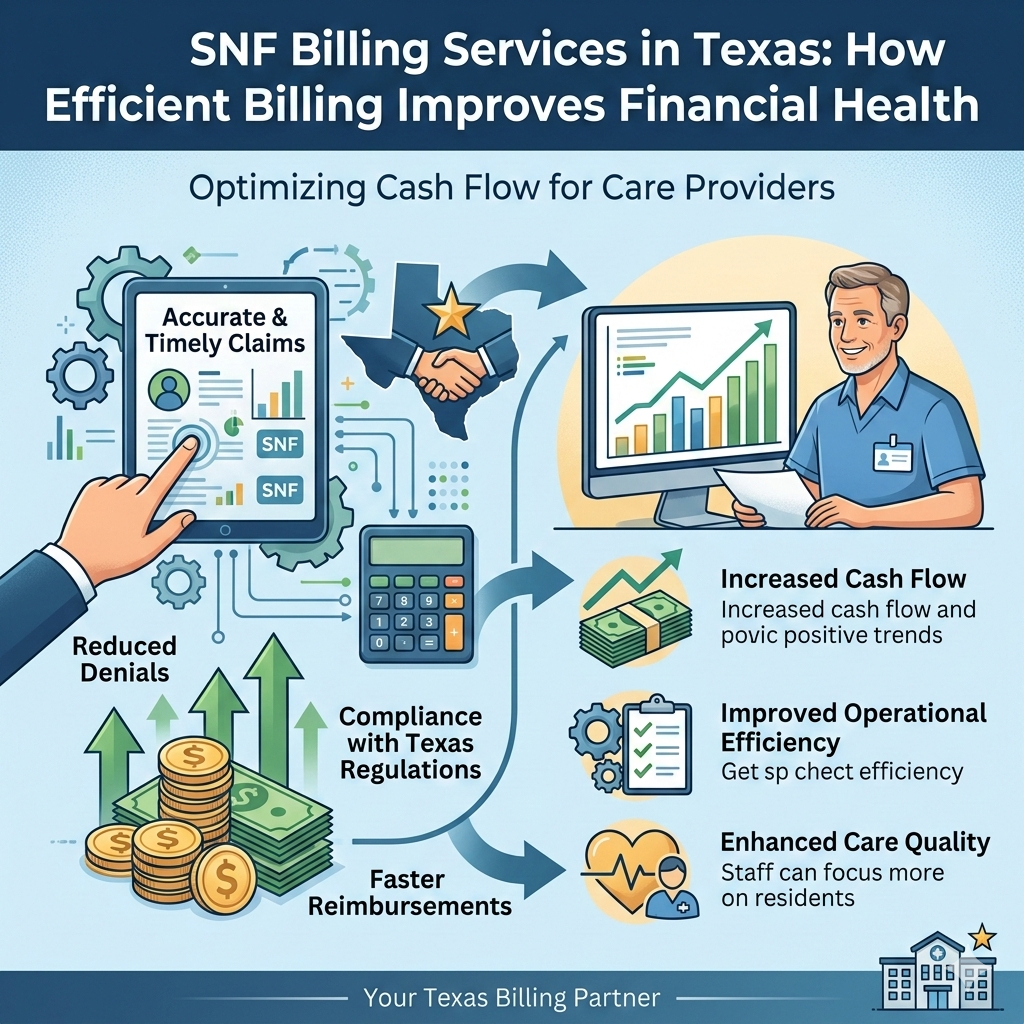
Professional SNF billing services help facilities improve efficiency and maintain financial stability through structured revenue cycle management.
Accurate claim submission to reduce rejection rates
Faster reimbursement cycles from Medicare and Medicaid
Improved compliance with federal and Texas regulations
Dedicated denial management processes
Reduced administrative workload for in-house staff
By partnering with experienced billing specialists such as 247 Medical Billing Services, Texas facilities can gain access to trained professionals who understand the specific needs of skilled nursing billing.
Revenue cycle management (RCM) in skilled nursing facilities involves several interconnected steps. Each stage must be handled correctly to ensure timely reimbursements.
Professional skilled nursing facility SNF billing services typically support the entire billing lifecycle.
Before treatment begins, insurance eligibility must be confirmed. Accurate verification ensures that services are covered and helps avoid unexpected payment issues later.
Certified medical coders translate clinical documentation into standardized billing codes. This process must align with PDPM guidelines and payer policies.
Once coding is complete, claims are submitted electronically to insurance providers. Efficient claim processing reduces delays and improves reimbursement timelines.
Denied claims are analyzed, corrected, and resubmitted quickly. Proactive denial management helps recover lost revenue.
Billing teams track payments, update financial records, and provide detailed reports that help facilities monitor their financial performance.
By handling these tasks professionally, SNF billing services ensure that revenue cycles remain smooth and predictable.
Across Texas, healthcare providers are increasingly outsourcing billing operations. This trend is driven by several factors.
Hiring and retaining experienced billing staff can be difficult and expensive. Outsourcing provides access to trained specialists without increasing payroll costs.
Modern billing systems require advanced software, analytics tools, and secure claim submission platforms. Billing service providers already have these technologies in place.
Billing errors can lead to compliance risks, audits, and financial penalties. Professional billing services stay updated with the latest regulatory changes.
When administrative tasks are outsourced, facility staff can focus more on patient care and operational improvements.
For many providers in Texas, outsourcing skilled nursing facility SNF billing services has become a strategic decision rather than a temporary solution.
In the evolving healthcare landscape, specialized billing partners play a crucial role in supporting skilled nursing facilities.
247 Medical Billing Services focuses on helping healthcare providers manage complex billing processes while maintaining accuracy and compliance. Their experience with SNF billing allows them to understand the challenges faced by facilities across Texas.
Their services typically include:
SNF claim submission and management
PDPM-compliant medical coding
Denial tracking and resolution
Revenue cycle analytics and reporting
Insurance verification and eligibility checks
By handling these responsibilities, billing partners allow facility administrators to concentrate on improving patient outcomes rather than navigating billing complications.
Even with professional billing support, facilities should follow best practices to ensure smooth revenue cycle management.
Proper clinical documentation ensures that claims are supported and compliant with payer requirements.
Clinical and administrative teams should understand how documentation affects billing and reimbursement.
Facilities should regularly track performance indicators such as:
Claim acceptance rates
Denial rates
Days in accounts receivable
Average reimbursement timelines
These metrics help identify potential billing issues early.
Working with professionals who specialize in skilled nursing facility SNF billing services can significantly reduce operational stress and improve financial outcomes.
Healthcare billing continues to evolve as regulations, technologies, and reimbursement models change. Skilled nursing facilities must remain adaptable in order to stay financially sustainable.
Several trends are shaping the future of SNF billing:
Automation and AI-assisted claim processing
Greater emphasis on data analytics
Value-based reimbursement models
Stricter compliance monitoring
Facilities that adopt efficient billing strategies today will be better positioned to handle these changes in the future.
Professional billing partners are expected to play an even larger role in helping facilities navigate these industry shifts.
Managing billing operations in skilled nursing facilities is a complex and time-consuming process. With multiple payer systems, evolving regulations, and strict documentation requirements, many Texas healthcare providers struggle to maintain efficient revenue cycles on their own.
This is why skilled nursing facility SNF billing services have become an essential solution for modern healthcare management. By outsourcing billing to experienced professionals, facilities can reduce claim denials, accelerate reimbursements, and ensure regulatory compliance.
Companies like 247 Medical Billing Services help skilled nursing facilities streamline their billing operations while allowing administrators and medical staff to focus on what matters most—delivering high-quality patient care.