Notifications

Invalid date
7 minutes, 38 seconds
50 views 0 comments 0 likes 0 reviews
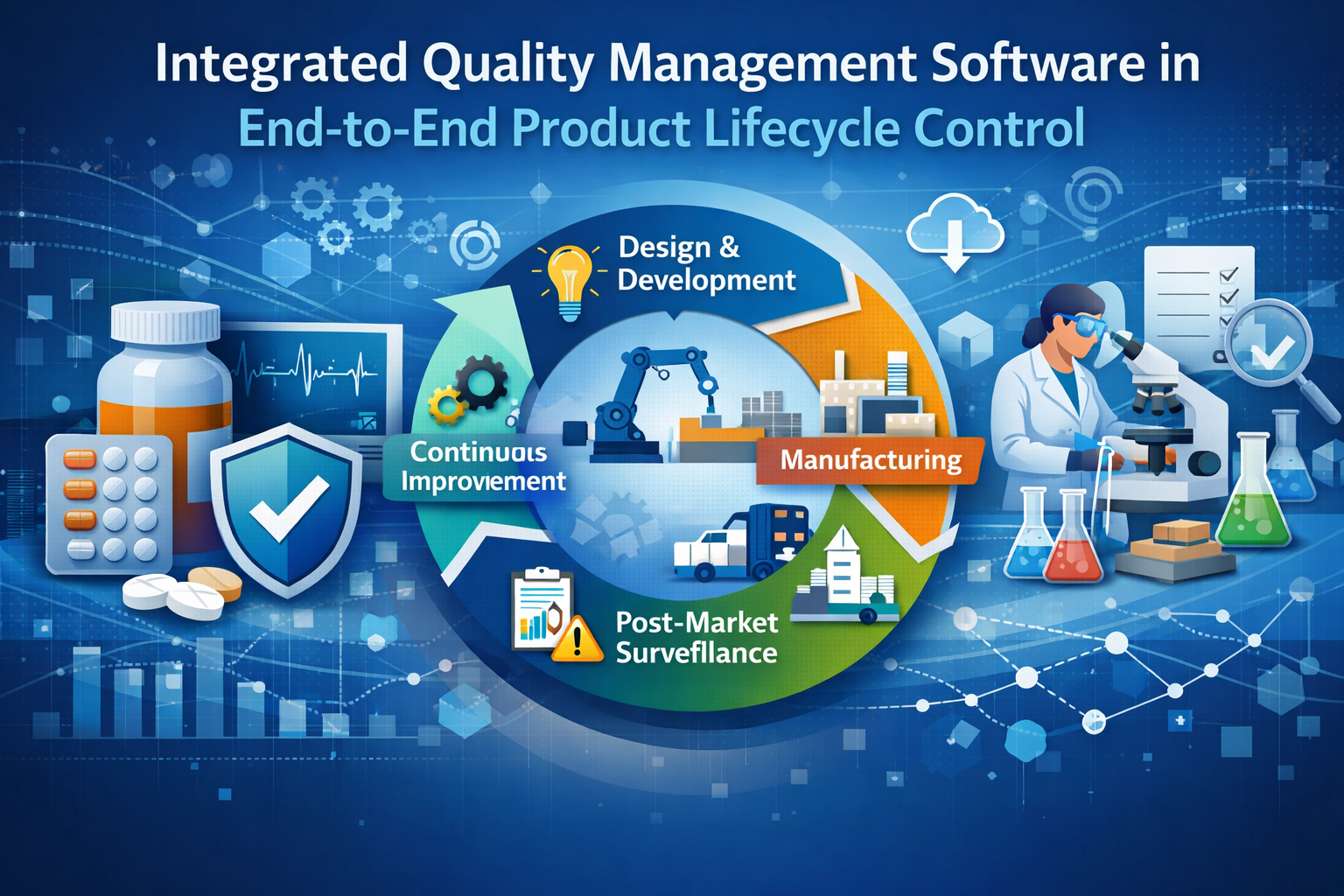
In highly regulated industries such as pharmaceuticals and medical devices, product quality is not confined to a single department or phase. It is built, monitored, validated, and improved across the entire product lifecycle—from initial design and development to manufacturing, distribution, and post-market surveillance. As regulatory expectations increase and product complexity grows, organizations are moving away from fragmented quality processes toward integrated Quality Management Software that enables true end-to-end product lifecycle control.
An integrated approach to quality management ensures that data, workflows, and decision-making are connected across functions, sites, and stages of the lifecycle. This connectivity is essential for maintaining compliance, reducing risk, accelerating time-to-market, and driving continuous improvement.
Traditional quality systems often operate in silos. Design controls may live in one system, supplier quality in another, and CAPA or audits in spreadsheets or disconnected tools. While these approaches may work at a small scale, they quickly become barriers as organizations grow, expand globally, or face stricter regulatory scrutiny.
End-to-end lifecycle control enables organizations to:
Maintain traceability from product requirements through design, production, and post-market feedback
Identify and mitigate risks earlier in the lifecycle
Ensure consistent quality processes across multiple sites and regions
Respond faster to nonconformances, deviations, and regulatory findings
Integrated Quality Management Software acts as the backbone that connects these lifecycle stages into a single, governed framework.
Modern Quality Management Software is designed to unify quality processes across the organization. Rather than treating quality as a reactive function, it embeds quality controls directly into product and process workflows.
At the core, an integrated quality platform supports:
Centralized quality data accessible across teams
Standardized workflows for audits, CAPA, change management, and risk management
Real-time visibility into quality metrics and trends
Controlled documentation and version management throughout the lifecycle
This foundation enables quality to move in parallel with product development and manufacturing, instead of lagging behind.
Quality outcomes are largely determined during the early phases of the product lifecycle. Integrated systems ensure that quality requirements, risk assessments, and design controls are aligned from day one.
During design and development, Quality Management Software supports:
Requirements management and traceability to design outputs
Risk identification and mitigation through structured risk management processes
Design reviews, approvals, and change control within controlled workflows
For organizations using a Pharmaceutical QMS or Medical device QMS, this level of traceability is critical for meeting regulatory expectations such as FDA design controls, ISO standards, and global compliance requirements.
By embedding quality controls early, organizations reduce costly rework, late-stage failures, and regulatory delays.
As products move into manufacturing, maintaining consistency and control becomes increasingly complex—especially across multiple facilities or contract manufacturers. Integrated QMS Software ensures that quality processes scale without losing governance.
Key benefits during manufacturing include:
Standardized deviation, nonconformance, and CAPA management
Automated audit scheduling, execution, and follow-up
Real-time visibility into quality issues across sites
Instead of relying on manual reporting or delayed insights, quality teams can proactively identify trends, systemic issues, and recurring risks. This enables faster corrective actions and more predictable manufacturing outcomes.
Suppliers and changes are two of the most common sources of quality risk across the product lifecycle. An integrated quality system connects supplier quality and change management directly to product impact.
With an integrated approach, organizations can:
Assess and monitor supplier performance and compliance
Link supplier issues directly to products, processes, and risk records
Evaluate change impact across quality, regulatory, and operational dimensions
This interconnected view ensures that changes are implemented with full visibility and that supplier-related risks are addressed before they escalate into compliance or safety issues.
The product lifecycle does not end at release. Complaints, adverse events, field actions, and customer feedback provide critical insights into real-world product performance.
Integrated Quality Management Software enables:
Seamless capture and investigation of complaints and incidents
Closed-loop feedback into risk management and CAPA processes
Data-driven continuous improvement based on lifecycle insights
For regulated industries, this closed-loop quality model is essential for maintaining compliance and demonstrating ongoing control to regulators.
One of the most significant advantages of integrated QMS Software is unified data visibility. When quality data is centralized and structured, organizations gain the ability to move from reactive compliance to proactive quality management.
This visibility supports:
Lifecycle-wide traceability and audit readiness
Predictive insights into quality risks and trends
Faster, more confident decision-making by quality and executive teams
Rather than chasing information across systems, teams can focus on improving outcomes and reducing risk.
Integrated Quality Management Software is no longer just a compliance tool—it is a strategic enabler. By connecting quality processes across the product lifecycle, organizations gain tighter control, improved efficiency, and greater agility in responding to change.
For pharmaceutical and medical device companies, this integration supports not only regulatory compliance but also innovation, scalability, and long-term business resilience.
This lifecycle-driven approach to quality is exactly where platforms like ComplianceQuest add value. Built natively on Salesforce, ComplianceQuest delivers an integrated Quality Management Software solution that connects quality processes across the entire product lifecycle—from design and manufacturing to post-market surveillance. By unifying data, workflows, and analytics on a single platform, ComplianceQuest helps organizations achieve end-to-end quality control while remaining agile, scalable, and audit-ready in today’s regulated environments.


