

Introduction
Digital tax transformation is becoming a major priority for governments around the world, and the United Arab Emirates is gradually moving toward a structured electronic invoicing framework. Businesses operating in the region, especially those using SAP Business One, are preparing their systems for regulatory compliance and digital reporting. This is where uae einvoicing b1 becomes an important topic for companies that want to remain compliant while maintaining efficient financial operations.
Organizations that rely on SAP Business One need a structured approach to integrate invoicing requirements into their ERP workflows. With increasing emphasis on digital tax reporting, companies must ensure their invoicing systems can generate, validate, and transmit electronic invoices according to regulatory guidelines. Businesses that manage their accounting through SAP Business One are exploring different strategies for integrating compliant electronic invoicing systems.
Companies searching for reliable solutions often look for integrations such as uae e-invoicing sap b1 or uae einvoicing sap b1 to align their ERP environment with future compliance standards. These integrations help businesses automate invoice creation, reduce manual processing, and ensure accurate financial documentation.
Understanding how electronic invoicing works within SAP Business One, and how companies can implement it effectively, is essential for organizations across industries including retail, manufacturing, logistics, and professional services.
Understanding UAE Einvoicing B1
The concept of uae einvoicing b1 refers to the integration of electronic invoicing capabilities within the SAP Business One ERP environment for businesses operating in the UAE. Instead of issuing traditional paper invoices or basic digital invoices, businesses generate structured electronic documents that can be validated and shared through approved digital channels.
Electronic invoicing typically involves:
• Automated invoice generation through ERP systems
• Standardized digital invoice formats
• Secure transmission between businesses and tax authorities
• Real-time or near real-time validation
• Digital archiving and record management
Companies using SAP Business One can configure their systems to support structured invoicing workflows. Many organizations implement solutions such as uae e-invoice sap b1 or uae einvoice sap b1 to streamline invoice processing and maintain compliance with digital tax regulations.
As governments encourage digital reporting, ERP-integrated solutions reduce the administrative burden on finance teams while improving transparency and accuracy in financial records.
Why SAP Business One Users Need UAE E-Invoicing Integration
SAP Business One is widely used by small and medium-sized enterprises. It manages accounting, inventory, sales, and procurement in a single platform. Integrating electronic invoicing into this environment helps businesses maintain consistent financial operations without relying on external manual processes.
Companies implementing uae e-invoicing for sap b1 benefit from several operational advantages.
Improved compliance
Electronic invoices generated through SAP Business One can follow regulatory standards and maintain structured documentation required by authorities.
Automation of financial workflows
When businesses deploy uae einvoicing for sap b1, invoice data flows directly from ERP transactions, eliminating repetitive manual entry.
Accurate tax reporting
Structured invoices improve accuracy in tax calculations and reduce compliance risks.
Better audit readiness
Digital invoices stored within ERP systems simplify audit procedures and financial verification.
Scalable digital operations
Companies implementing uae e-invoice for sap b1 can easily scale their invoicing systems as transaction volumes grow.
Because SAP Business One already manages financial and operational data, adding electronic invoicing capabilities ensures that invoices are created from accurate source transactions.
Key Components of UAE SAP B1 E-Invoicing
A successful electronic invoicing setup within SAP Business One includes several technical and operational components.
ERP Integration
ERP integration ensures that invoice data is generated directly from sales transactions within SAP Business One. Businesses adopting uae sap b1 e-invoicing or uae sap b1 einvoicing configure their ERP system to produce structured invoice data.
Invoice Validation
Before sending invoices electronically, the system verifies required data fields such as tax details, supplier information, and invoice values. Validation prevents errors and ensures regulatory compliance.
Digital Transmission
Invoices must be transmitted securely through approved electronic channels. Systems implementing uae sap b1 e-invoice or uae sap b1 einvoice typically connect to external platforms or middleware that manage document transmission.
Secure Storage
Electronic invoices must be stored securely for regulatory and auditing purposes. SAP Business One can maintain digital archives within integrated document management systems.
Reporting and Monitoring
Businesses need real-time visibility into invoice submissions and validation results. Monitoring tools allow finance teams to track invoice statuses and quickly address any rejected transactions.
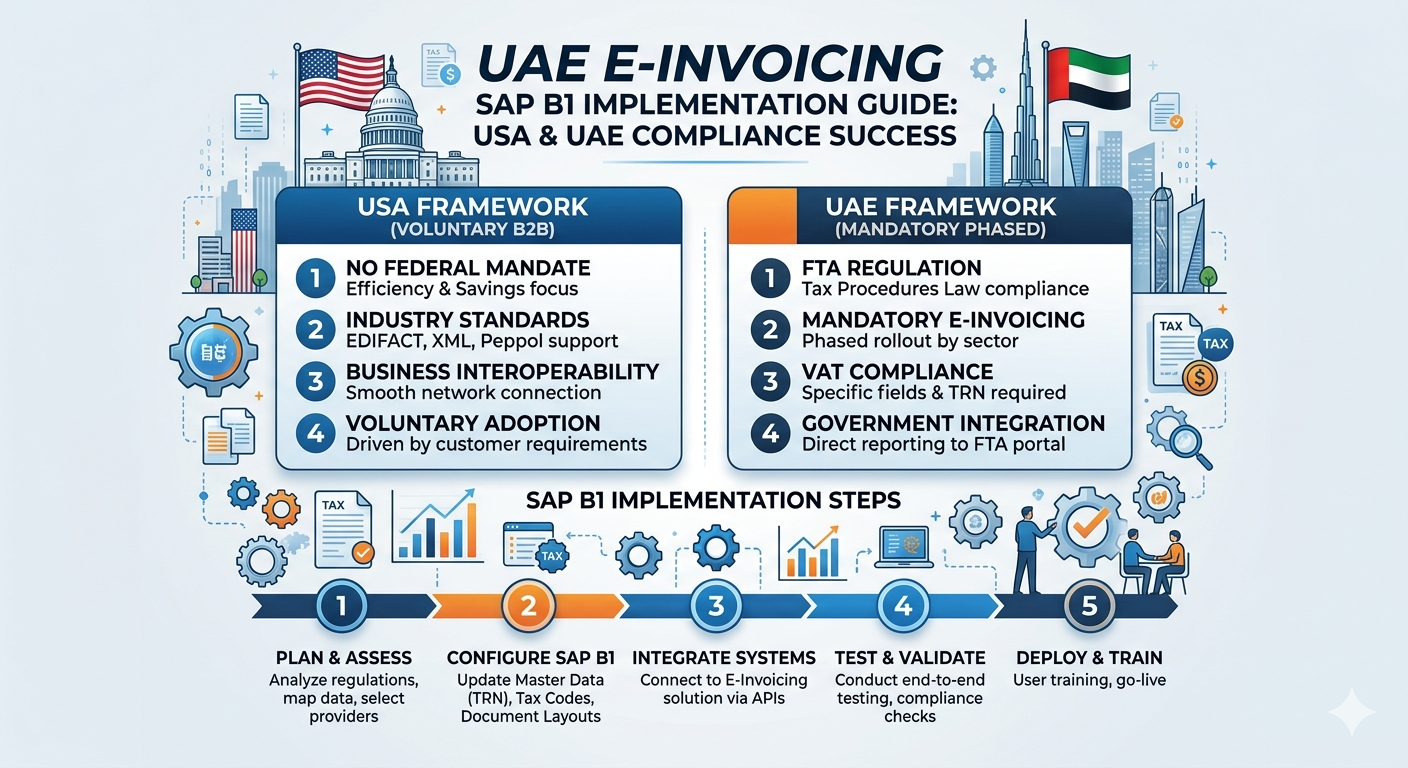
Steps to Implement UAE Einvoicing B1 in SAP Business One
Implementing electronic invoicing within SAP Business One requires a structured approach. Businesses typically follow these key steps.
1. Compliance Assessment
Companies begin by analyzing regulatory requirements and determining how they apply to their operations. This includes reviewing invoicing formats, tax reporting obligations, and digital submission standards.
2. ERP System Evaluation
The existing SAP Business One configuration must be evaluated to ensure compatibility with electronic invoicing frameworks. Many organizations work with specialists to configure uae e-invoicing sap b1 solutions that integrate seamlessly with their ERP.
3. Integration Setup
The ERP system is connected to middleware or government-approved platforms that manage invoice validation and transmission.
4. Testing and Validation
Before full deployment, businesses test the electronic invoicing system using sample invoices. This process ensures that invoices generated through uae einvoicing sap b1 meet required data standards.
5. Deployment and Training
Once testing is complete, the system is deployed across the organization. Finance teams receive training on managing electronic invoices, monitoring system alerts, and handling exceptions.
Benefits of UAE E-Invoice SAP B1 Integration
Businesses adopting electronic invoicing through SAP Business One experience multiple operational and strategic benefits.
Faster invoicing cycles
Automated invoice generation accelerates billing processes and improves cash flow.
Reduced administrative costs
Manual invoice processing is time-consuming. Systems implementing uae einvoice sap b1 reduce paperwork and operational overhead.
Increased data accuracy
ERP-based invoicing eliminates duplication of data entry and minimizes human errors.
Stronger regulatory compliance
Digital invoice validation ensures that all required data fields are present and correct.
Enhanced financial transparency
Structured invoice records improve financial visibility and reporting accuracy.
UAE SAP B1 E-Invoicing Across Different Emirates
Businesses across the UAE are preparing for digital invoicing adoption. SAP Business One users in various emirates are implementing ERP integrations to ensure compliance.
Abu Dhabi
Organizations implementing sap b1 e-invoicing abu dhabi are focusing on ERP integrations that support large transaction volumes and government reporting requirements. Businesses also explore sap b1 einvoicing abu dhabi solutions to streamline their accounting processes.
Companies managing ERP systems in the capital also use sap b1 e-invoice abu dhabi or sap b1 einvoice abu dhabi integrations to improve digital invoice management.
Dubai
Dubai hosts thousands of SMEs using SAP Business One. Businesses implementing sap b1 e-invoicing dubai or sap b1 einvoicing dubai solutions are prioritizing automation and digital tax compliance.
Many companies also adopt sap b1 e-invoice dubai or sap b1 einvoice dubai frameworks to ensure that their ERP systems align with digital reporting requirements.
Sharjah
Growing industrial and trading companies in Sharjah are adopting sap b1 e-invoicing sharjah integrations to improve operational efficiency and financial transparency.
Ajman
Businesses in Ajman increasingly implement sap b1 e-invoicing ajman solutions to modernize their accounting processes and support digital transformation.
Fujairah
Organizations exploring digital tax readiness often deploy sap b1 e-invoicing fujairah integrations within their ERP environment.
Umm Al Quwain
Companies in smaller emirates are also preparing for digital invoicing adoption by implementing sap b1 e-invoicing umm al quwain solutions.
Ras Al Khaimah
Manufacturing and trading businesses in the region are adopting sap b1 e-invoicing ras al khaimah to improve financial reporting and regulatory readiness.
Common Challenges in UAE Einvoicing Implementation
Although electronic invoicing offers many benefits, businesses may face certain challenges during implementation.
ERP customization complexity
Every organization configures SAP Business One differently. Integration solutions must be adapted to each company's workflow.
Data accuracy issues
Incomplete or inconsistent data can cause invoice validation failures.
Staff training requirements
Finance teams must learn how to manage electronic invoice systems and monitor compliance alerts.
Integration costs
Initial setup costs may include ERP configuration, middleware integration, and testing processes.
Working with experienced ERP consultants helps organizations overcome these challenges and achieve smooth system deployment.
Best Practices for Successful UAE Einvoicing B1 Implementation
Businesses planning electronic invoicing integration can follow several best practices.
Conduct a complete ERP audit before implementation
Ensure invoice data fields follow standardized formats
Choose experienced SAP Business One integration partners
Test invoicing workflows before full deployment
Provide proper training for finance and accounting teams
Implement strong data validation processes
These practices help companies maximize the efficiency of their electronic invoicing systems.
The Future of Digital Invoicing in the UAE
The UAE continues to strengthen its digital tax infrastructure as part of broader economic modernization initiatives. Electronic invoicing will play a critical role in improving transparency, reducing tax evasion, and simplifying compliance procedures for businesses.
SAP Business One users who implement uae einvoicing b1 early will be better prepared for future regulatory updates. Organizations that integrate structured digital invoicing into their ERP systems can also gain long-term operational advantages, including faster reporting and improved financial analytics.
As digital tax ecosystems expand globally, companies that adopt advanced ERP-based invoicing solutions will remain competitive in both regional and international markets.
Conclusion
Electronic invoicing is becoming a key component of modern financial management for businesses operating in the UAE. Organizations using SAP Business One must ensure their ERP systems can support structured invoice generation, validation, and reporting.
Implementing uae einvoicing b1 allows companies to automate invoicing processes, reduce manual errors, and maintain compliance with digital tax frameworks. Solutions such as uae e-invoicing sap b1, uae einvoicing for sap b1, and uae sap b1 e-invoicing enable businesses to integrate electronic invoicing directly within their ERP systems.
Businesses across Abu Dhabi, Dubai, Sharjah, Ajman, Fujairah, Umm Al Quwain, and Ras Al Khaimah are preparing for digital invoicing adoption by integrating electronic invoice solutions into SAP Business One.
By investing in the right technology and implementation strategy, companies can streamline their financial operations, improve transparency, and stay ahead of evolving regulatory requirements.
Organizations that adopt electronic invoicing early will benefit from improved efficiency, compliance readiness, and a stronger digital foundation for future business growth.


