Notifications

6 minutes, 46 seconds
-59 Views 0 Comments 0 Likes 0 Reviews
VESDA Smoke Detection Solutions represent one of the most advanced approaches to fire detection in critical environments. Unlike traditional detectors, these systems actively draw air samples through a network of pipes to detect even the smallest traces of smoke at a very early stage.
In modern infrastructure where CCTV cameras, IP cameras, IP speakers, and advanced surveillance systems are already in place, integrating intelligent fire detection adds another layer of protection. Aspirating Smoke Detection (ASD) is particularly useful in areas where early warning is crucial, such as data centres, server rooms, warehouses, and high-value asset environments.
VESDA Smoke Detection Solutions – Understanding the Technology
VESDA Smoke Detection Solutions work on a simple yet highly effective principle. Instead of waiting for smoke to reach the detector, the system continuously draws air into a detection chamber using a network of sampling pipes.
Inside the chamber, highly sensitive sensors analyse the air for microscopic smoke particles. This allows detection at a much earlier stage compared to conventional smoke detectors.
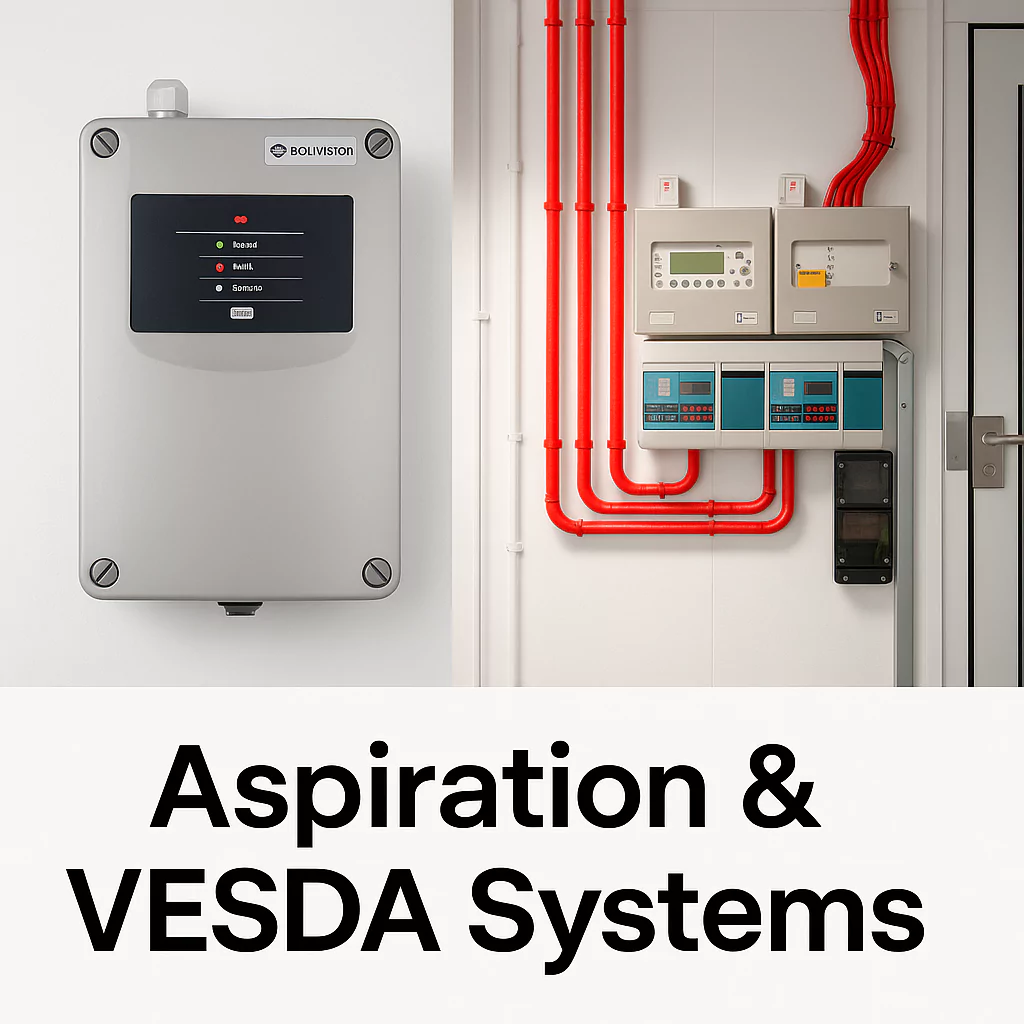
Aspiration Smoke Detection Solutions
This method ensures:
Faster response time
Higher sensitivity
Reduced false alarms
Continuous air monitoring
These systems are especially suitable for environments where even a minor delay in detection can lead to serious consequences.
How Aspirating Smoke Detection (ASD) Works
The working of ASD systems can be broken down into key steps:
Air Sampling
A network of pipes with small holes continuously draws air from protected areas.
Detection Chamber Analysis
The air is analysed using advanced laser-based or optical sensors.
Alert Generation
If smoke particles are detected, alerts are triggered at different levels depending on severity.
Integration with Security Systems
ASD systems can integrate with CCTV, access control, and alarm systems for automated response.
VESDA Smoke Detection Solutions in Modern Security Systems
VESDA Smoke Detection Solutions play a vital role in enhancing overall security infrastructure. For businesses already investing in IP cameras, thermal CCTV, and networking systems, ASD adds intelligence to fire safety.
Key integration benefits include:
Automatic alerts on surveillance dashboards
Triggering voice evacuation systems
Activating access control protocols
Integration with building management systems
This ensures a unified and responsive safety ecosystem.
Key Advantages of Aspirating Smoke Detection Systems
Early Warning Capability
Detects smoke at a very early stage, even before visible smoke appears.
High Sensitivity
Capable of detecting minute particles that traditional detectors may miss.
Flexible Installation
Suitable for both small and large environments.
Low Maintenance
Centralised detection units reduce maintenance complexity.
Aesthetic Installation
Sampling pipes can be hidden, making it ideal for clean environments.
VESDA Smoke Detection Solutions for Critical Applications
VESDA Smoke Detection Solutions are widely used in environments where precision and reliability are essential.
Common applications include:
Data centres and server rooms
Industrial facilities
Warehouses
Airports and transportation hubs
Hospitals and healthcare facilities
In such environments, combining ASD with networking accessories and structured cabling ensures seamless communication between devices.
Comparison: ASD vs Traditional Smoke Detectors
|
Feature |
ASD Systems |
Traditional Detectors |
|
Detection Speed |
Very Early |
Moderate |
|
Sensitivity |
High |
Standard |
|
Coverage Area |
Large |
Limited |
|
Maintenance |
Centralised |
Distributed |
|
False Alarms |
Low |
Higher |
This comparison highlights why ASD is becoming a preferred choice for advanced safety systems.
VESDA systems and Their Role in Smart Infrastructure
VESDA systems are designed to work efficiently in intelligent buildings where automation and safety go hand in hand. When integrated with IP-based surveillance, mobile recorders, and voice evacuation systems, they provide real-time monitoring and quick response.
These systems also support scalability, allowing businesses to expand their safety infrastructure without major changes.
When implementing ASD systems, it is important to consider:
Proper pipe network design
Airflow analysis of the environment
Integration with existing security systems
Regular testing and calibration
A well-designed system ensures optimal performance and reliability.
FAQs
1. What is Aspirating Smoke Detection (ASD)?
ASD is a fire detection method that actively samples air through pipes to detect smoke particles at an early stage.
2. Where are ASD systems commonly used?
They are widely used in data centres, warehouses, and critical infrastructure environments where early detection is essential.
3. How is ASD different from conventional smoke detectors?
ASD systems detect smoke much earlier by continuously analysing air samples, while conventional detectors rely on passive detection.
4. Are ASD systems compatible with modern security solutions?
Yes, they can integrate with CCTV, access control, and alarm systems for unified monitoring.
5. Do ASD systems require frequent maintenance?
No, they generally require less maintenance because detection units are centralised and easier to access.
Conclusion
VESDA Smoke Detection Solutions are redefining fire safety standards in modern infrastructure. From my perspective as someone closely observing evolving security technologies, ASD is not just an upgrade but a necessity for environments that demand precision, reliability, and early intervention.
As surveillance systems like IP cameras, thermal CCTV, and networking solutions continue to advance, integrating intelligent fire detection ensures complete protection. Businesses that adopt such proactive safety measures position themselves ahead in both security and operational efficiency.