Notifications

9 minutes, 29 seconds
-430 Views 0 Comments 0 Likes 0 Reviews
In a fast-moving industrial economy where efficiency, safety, and equipment longevity are paramount, selecting quality components is more critical than ever. Among these components, few play a more important role in hydraulic systems than the Hydraulic Cylinder Tube. While often overshadowed by other system elements, the quality of the hydraulic cylinder tube can make or break system performance—impacting not only the equipment’s functionality but also its safety, operating cost, and lifespan.
As a leading manufacturer and exporter of high-performance steel components, Shandong Baokun Metal Material Co., Ltd. sheds light on the importance of selecting the right hydraulic cylinder tube for any industrial application. Ms. Sun, Sales Director and Spokesperson for the company, articulates the urgency of industry-wide awareness on this vital but underappreciated component.
“Hydraulic cylinder tubes are the core structural element of the cylinder housing,” says Ms. Sun. “They are responsible for guiding the piston, withstanding internal pressures, and ensuring operational reliability. A low-quality tube can lead to leakage, misalignment, rapid wear, and even catastrophic failure. That’s why quality should be a top priority—not an afterthought.”
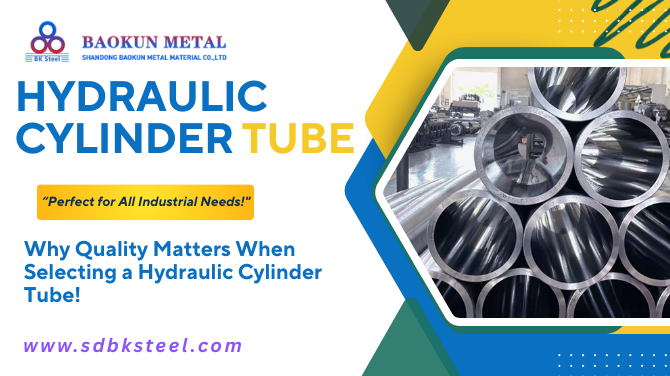
A hydraulic cylinder tube, also known as a honed tube or seamless hydraulic tube, is the inner shell of a hydraulic cylinder. It usually consists of precision-honed steel designed to provide an ultra-smooth internal surface for guiding a piston rod with minimal friction.
Proper internal surface finish ensures that seals glide efficiently, pressure is evenly distributed, and internal wear is kept to a minimum. Hydraulic cylinder tubes are used in numerous applications across industries including:
Not all hydraulic cylinder tubes are created equal. Selecting a poor-quality tube may save short-term costs but introduces long-term risks, including breakdowns, costly replacements, and safety hazards.
1. Pressure Stability
Hydraulic cylinders operate under extreme pressures, often exceeding 3000 PSI. Low-grade tubes may have inconsistent wall thickness, hidden inclusions, or surface defects that compromise pressure retention. High-quality tubes, on the other hand, are tested for bursting strength and wall uniformity, ensuring they meet international standards such as DIN 2391, EN 10305-1 and ASTM A519.
2. Dimensional Accuracy
Hydraulic systems rely on tight dimensional tolerances to reduce leak paths and friction. Top-quality hydraulic cylinder tubes are honed to Ra 0.2 µm or better, with ID tolerances as tight as H8 or H9. These specifications enable longer seal life and minimized wear.
3. Surface Hardness and Finish
Honing not only improves roundness and straightness but also produces a mirror-like finish inside the tube. This reduces kinetic wear and helps maintain smooth piston motion. Inferior surface finishes can result in early seal failure or uneven piston travel.
4. Corrosion Resistance
Depending on the environment and application, tubes may be exposed to humidity, water, or even caustic chemicals. Use of incorrectly specified or untreated tubing increases the risk of rust, which drastically shortens the component's lifespan. Quality manufacturers like Shandong Baokun offer corrosion-resistant coatings or utilize higher-grade alloy steels for critical applications.
5. Weldability and Machinability
In manufacturing custom cylinders, tubes must be adaptable to processes like welding, threading, grooving, or porting. Premium-grade cylinder tubes offer consistent mechanical properties, making them easier to weld and machine without cracking or deformation.
The Baokun Advantage: Built for Performance
Shandong Baokun Metal Material Co., Ltd. produces a wide range of hydraulic cylinder tubes, including:
With advanced production lines and high-precision honing machines, Baokun achieves:
“Our customers rely on us because we offer not just a product, but a high-precision engineered solution,” adds Ms. Sun. “We test 100% of our tubes for straightness, uniformity, and surface integrity. We believe consistency is key to maintaining trust and system performance.”
In these sectors, slight errors in tube manufacturing can result in catastrophic failures—a risk no company can afford to ignore.
Key Considerations When Selecting a Hydraulic Cylinder Tube:
For engineers, procurement managers, and manufacturers, the selection process must be thorough. Ms. Sun outlines the 8 key factors:
Quality Certifications and Testing at Baokun
Shandong Baokun ensures all products undergo rigorous testing, including:
The company is certified under ISO 9001:2015, and serves clients across Asia, North America, Europe, and the Middle East.
As hydraulic systems become more advanced and integral across industries, it’s increasingly urgent that every component—especially the Hydraulic Cylinder Tube—meets the highest quality, precision, and performance standards. Choosing a superior quality tube doesn’t just reduce downtime or prevent system failure—it safeguards your entire operation.
Answer: Honed tubes use an abrasive tool to remove excess material, ideal for precise ID surfaces. Skived roller burnished tubes use cutting followed by cold working, making them faster to produce but sometimes less dimensional precise than honed tubes.
Answer: Absolutely. Baokun manufactures to order, offering custom ID, OD, and wall thickness combinations up to 12 meters in single-piece lengths.
Answer: Yes, Baokun provides “ready-to-hone,” “honed,” or “ready-to-install” tubes based on customer requirements.
Answer: Yes. Special high-impact grades and tolerances make our hydraulic cylinder tubes ideal for single or multi-stage telescopic cylinders.
Answer: Each batch includes Mill Test Certificate (EN 10204 3.1 or 3.2), chemical composition, mechanical properties, and full QC records.
Answer: Standard lead time is 15–25 days, with expedited options available for urgent orders.


