Notifications

8 minutes, 1 second
-14 Views 0 Comments 0 Likes 0 Reviews
The construction industry is undergoing a significant digital transformation. Traditional workflows that once relied heavily on manual measurements, 2D drawings, and on-site adjustments are rapidly evolving into data-driven, model-based processes. At the center of this shift is Scan to BIM a technology-driven workflow that is redefining how projects are planned, designed, and executed.
By converting precise 3D scan data into intelligent Building Information Models, Scan to BIM is improving accuracy, reducing risk, and enabling smarter decision-making across the project lifecycle. From renovation projects to complex infrastructure developments, this approach is reshaping the way construction professionals operate.
For decades, site surveys were performed using manual tools and conventional equipment. While effective to some extent, these methods were time-consuming and prone to human error. In complex buildings with dense structural and MEP systems, capturing every detail accurately was nearly impossible.
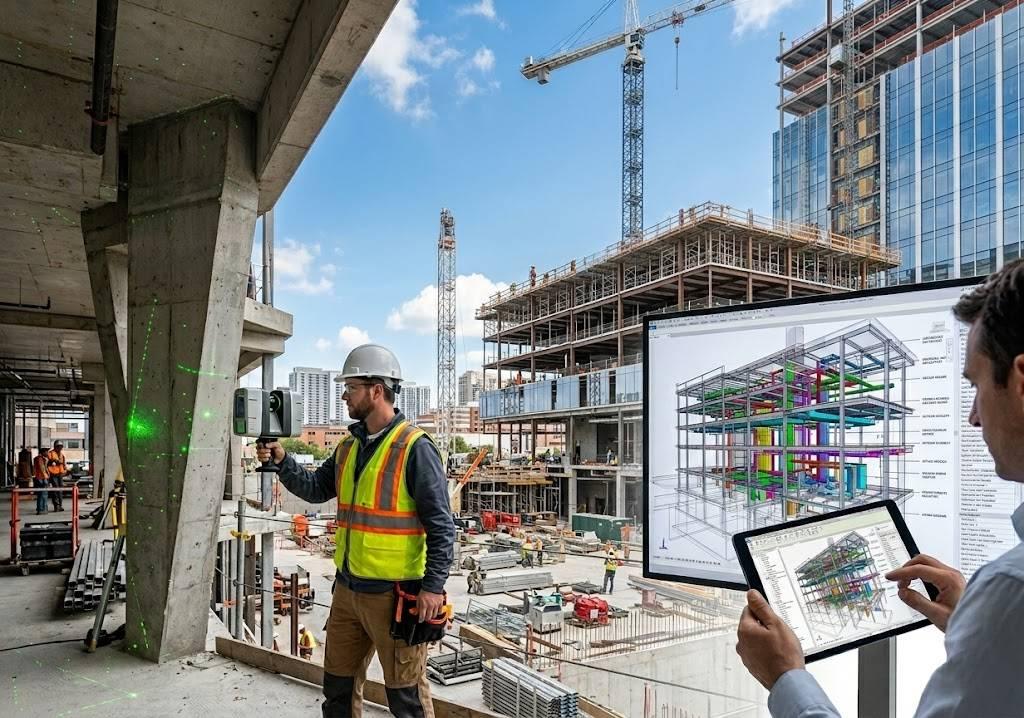
Scan to BIM replaces guesswork with precision. Advanced laser scanning and LiDAR technology capture millions of data points that represent the exact geometry of a building. These data points form a detailed digital representation of real-world conditions, which can then be converted into an intelligent BIM model.
The result is a reliable foundation for planning and design one that reflects reality instead of assumptions.
Accuracy is critical in every stage of construction. Even minor dimensional discrepancies can lead to costly conflicts and delays. Scan-based modeling significantly reduces these risks.
With accurate existing-condition models:
Architects design with confidence
Engineers coordinate systems efficiently
Contractors minimize installation errors
Fabricators produce precise prefabricated components
When teams work from a model that mirrors actual site conditions, the margin for error decreases dramatically. This precision leads to smoother workflows and fewer unexpected site issues.
Renovation projects are often more complex than new construction because they involve working within existing structures. Hidden utilities, misaligned walls, and undocumented modifications can create major obstacles.
Scan to BIM provides a clear understanding of current site conditions before design begins. Detailed digital models allow teams to identify potential conflicts early, adjust designs accordingly, and avoid disruptive surprises during construction.
This proactive approach reduces downtime and improves project predictability, particularly in commercial, healthcare, and industrial facilities where operational continuity is crucial.
Modern construction projects involve multiple stakeholders, including architects, structural engineers, MEP consultants, contractors, and facility managers. Effective collaboration requires accurate and shared information.
Scan to BIM enhances coordination by providing a centralized, data-rich model that all stakeholders can reference. Clash detection becomes more reliable, and design revisions can be made with clarity and confidence.
Professional Scan to BIM Services play a key role in delivering structured models that meet project-specific requirements. By ensuring accurate modeling standards and proper data integration, these services support seamless collaboration across teams.
Prefabrication and modular construction are gaining popularity due to their efficiency and cost-saving benefits. However, prefabricated components must fit precisely within existing conditions. Even small measurement errors can cause alignment issues during installation.
Scan-based modeling ensures that prefabricated elements are designed using exact dimensions from the site. This alignment reduces material waste, shortens installation time, and improves overall project efficiency.
As off-site construction methods continue to grow, the importance of precise digital models will only increase.
Construction projects inherently carry risks related to cost overruns, schedule delays, and safety concerns. Many of these risks stem from inaccurate or incomplete site information.
Scan to BIM improves risk management by providing dependable data at the outset. With clear visibility into existing conditions, project teams can anticipate challenges, plan effectively, and reduce uncertainties.
Additionally, LiDAR Scan to BIM Services enable highly detailed capture of complex environments, including industrial plants and infrastructure facilities. The enhanced precision supports better planning, especially in projects where safety and compliance are critical.
The impact of Scan to BIM extends beyond construction. Once a project is complete, the BIM model serves as a valuable resource for facility management.
Accurate digital models help facility managers:
Track building assets
Plan maintenance schedules
Evaluate system performance
Manage future renovations
Because the model is based on real-world scan data, it offers reliable insights that improve operational efficiency over the building’s lifecycle.
The construction industry is shifting toward analytics and digital integration. Technologies such as 4D scheduling, 5D cost estimation, and digital twins depend on accurate baseline models.
Scan to BIM provides the high-quality data needed to power these advanced tools. When project teams rely on precise digital representations, they can simulate construction sequences, forecast costs, and evaluate design alternatives with greater confidence.
This data-driven approach leads to better decisions, improved transparency, and stronger project outcomes.
Scan to BIM is not just a technical upgrade; it represents a broader change in how construction professionals approach projects. By integrating accurate scanning technology with intelligent modeling, the industry is moving toward greater efficiency, transparency, and collaboration.
As projects become more complex and client expectations continue to rise, the demand for precision and accountability grows. Scan to BIM addresses these challenges by delivering reliable digital foundations that support innovation and progress.
The construction industry is evolving rapidly, and accuracy has become a non-negotiable requirement. Scan to BIM is reshaping the industry by replacing traditional survey limitations with precise, data-driven modeling.
From improving renovation planning and coordination to supporting prefabrication and facility management, this technology enhances every stage of the building lifecycle. By leveraging structured workflows and expert implementation, construction professionals can reduce risk, increase efficiency, and deliver higher-quality outcomes.
As digital transformation continues to accelerate, Scan to BIM stands as a powerful catalyst driving the future of modern construction.


