Notifications


7 minutes, 9 seconds
-52 Views 0 Comments 0 Likes 0 Reviews
The transition to clean energy in India is accelerating, driven by both ambitious national targets and growing corporate demand for sustainable solutions. For EPC contractors, infrastructure developers, and energy consultants, understanding the types of solar panels available in India is critical to designing efficient and cost-effective solar projects.
Whether you're working on utility-scale solar farms or large industrial rooftops, selecting the right types of solar panels directly impacts project performance, return on investment, and long-term reliability. This guide explores the different types of solar panels in India and provides key considerations for EPC professionals operating in the renewable energy ecosystem.
India's solar market has evolved significantly in recent years. With increasing emphasis on custom-built energy solutions, EPC players must go beyond one-size-fits-all choices. The types of solar panels in India vary in terms of material, efficiency, space requirements, cost, and lifespan — all of which influence the overall project blueprint.
For projects under development by EPC firms like Hartek Group, knowing which panel type best suits a particular site condition or project goal ensures technical feasibility and commercial success.
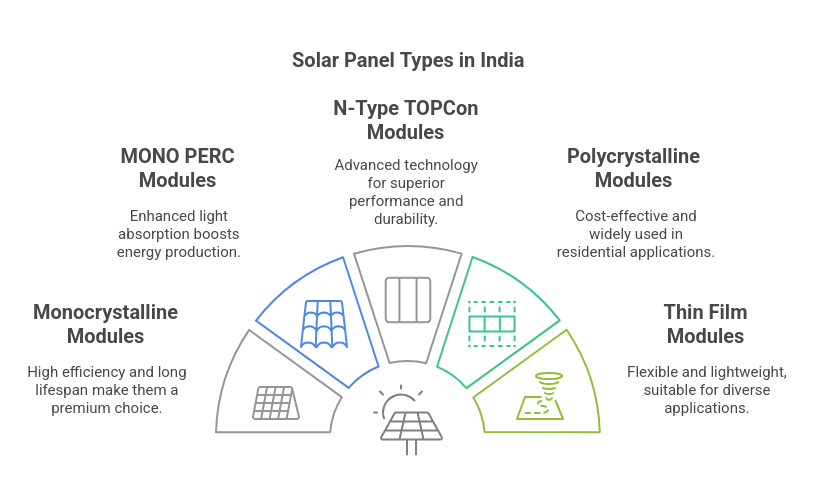
Let’s explore the different types of solar panels used across India's commercial and industrial solar installations.
Efficiency: 18% – 22%
Lifespan: 25+ years
Best for: Limited space projects with high power requirements
These panels are made from single-crystal silicon and are known for their sleek black appearance. They offer the highest efficiency among all types of solar panels, making them ideal for commercial rooftops or land-constrained utility projects. However, they are more expensive compared to other types.
Efficiency: 15% – 17%
Lifespan: 20 – 25 years
Best for: Large open area projects focused on cost-efficiency
Polycrystalline panels, recognized by their blue color and square-cut cells, are widely used across India due to their balance of performance and affordability. For developers executing MW-scale installations in rural or semi-urban areas, polycrystalline panels remain a practical choice.
Efficiency: 10% – 13%
Lifespan: 10 – 20 years
Best for: Lightweight, flexible applications like building-integrated photovoltaics (BIPV)
Thin-film panels are manufactured using materials like cadmium telluride (CdTe) or amorphous silicon. While they have lower efficiency compared to crystalline types, they offer flexibility and aesthetic advantages. Their performance under low light or high-temperature conditions also makes them suitable for select industrial or transport applications.
Efficiency Boost: Up to 30% more than traditional panels (via rear-side generation)
Best for: Ground-mounted installations with reflective surfaces
An increasingly popular option in solar panel types in India, bifacial panels generate electricity from both sides of the panel. EPC companies integrating these panels into projects often benefit from higher yield and better levelized cost of energy (LCOE), especially in reflective terrain or desert regions.
Efficiency: Up to 23%
Best for: High-performance commercial and industrial projects
PERC panels enhance energy capture by reflecting light back into the solar cell, improving performance. These panels can be either monocrystalline or polycrystalline but feature added rear surface passivation that reduces recombination losses. EPC contractors who prioritize cutting-edge solutions increasingly opt for PERC technology.
For EPC and power sector leaders evaluating all types of solar panels, it’s essential to consider several project-specific factors before finalizing a technology:
Dust levels, temperature, shading, and roof orientation significantly affect which types of solar panel systems are optimal.
Premium projects with strict performance KPIs may benefit from monocrystalline or PERC technologies due to their superior efficiency.
Polycrystalline and thin-film options help reduce upfront costs, although trade-offs in efficiency must be calculated.
For rooftop projects, panel efficiency determines how much energy can be generated per square meter — a crucial aspect when space is limited.
Higher efficiency panels often demand less area and cleaning effort, impacting long-term O&M costs.
India's solar industry is embracing innovation rapidly. From bifacial and TOPCon (Tunnel Oxide Passivated Contact) technologies to floating solar systems, the future will see greater diversification in types of solar panel systems.
Manufacturers are investing in higher wattage modules and smart panels integrated with IoT and SCADA systems. For EPC companies like Hartek Group, staying ahead of these trends allows them to offer turnkey solutions with higher energy yield and project bankability.
With the increasing complexity and scale of solar EPC projects in India, simply choosing a panel based on price is no longer viable. Leaders in the power and infrastructure sector must evaluate the types of solar panels available in India through a strategic lens—balancing performance, cost, and long-term project value.
At Hartek Group, our team leverages deep technical knowledge to match the most appropriate types of solar panels to each client’s unique energy needs, ensuring optimal returns on solar investments.
Want help choosing the right solar panel technology for your project? Contact Hartek Group for tailored EPC consultation and expert solar panel selection support.
types of solar panels types of solar panel types of solar panels in india solar panel types in india