
Digital transformation has evolved far beyond the adoption of isolated technologies. Modern enterprises operate within interconnected ecosystems where applications, devices, cloud platforms, and data systems must work together seamlessly. In this rapidly evolving landscape, an AI Agent development company plays a crucial role in enabling organizations to implement intelligent systems capable of operating across multiple digital platforms.
AI agents represent a new generation of software intelligence designed to perceive information, interpret data patterns, and execute tasks autonomously. Their ability to interact with various systems—ranging from enterprise applications to IoT networks—makes them powerful drivers of cross-platform digital transformation.
The Evolution from Automation to Intelligent Agents
Early automation tools were built on predefined rules and structured workflows. While these systems improved operational efficiency, they lacked the flexibility to adapt to complex or unpredictable environments.
AI agents, by contrast, use advanced machine learning models and contextual understanding to analyze situations and respond dynamically. Supported by advancements from organizations such as OpenAI, modern AI systems can process natural language, recognize patterns within massive datasets, and continuously improve through feedback loops.
An experienced AI Agent Development Company helps enterprises design these intelligent agents so they can interact with diverse systems and make informed decisions in real time. Instead of relying on static automation scripts, businesses gain adaptive digital systems that evolve alongside their operational needs.
Enabling Cross-Platform Intelligence
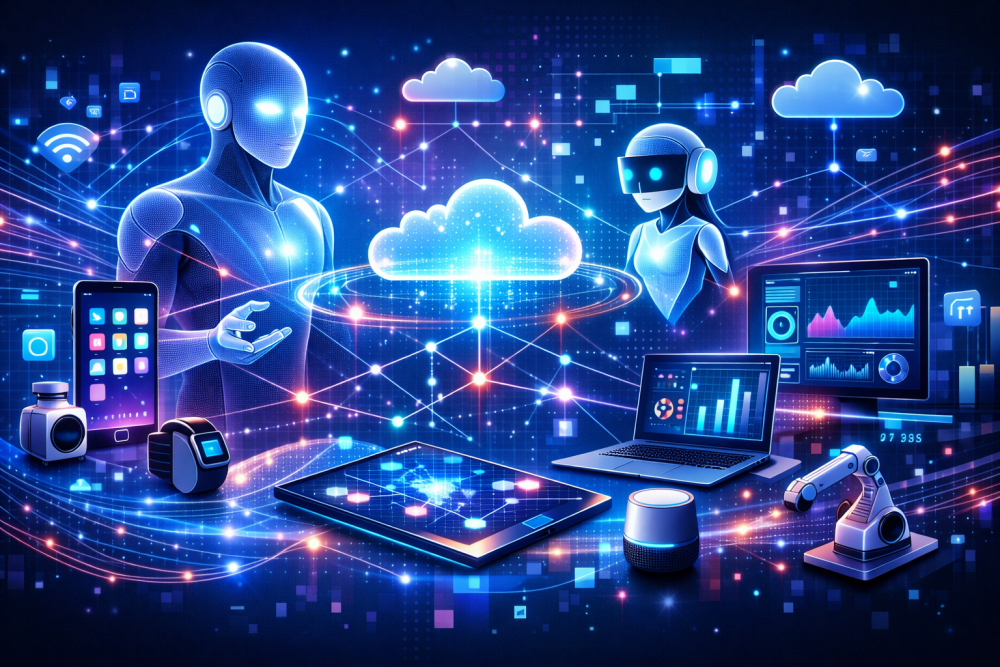
One of the most valuable characteristics of AI agents is their ability to function across different digital environments. Enterprises typically rely on a variety of platforms including mobile applications, enterprise software, IoT networks, and cloud-based services.
AI agents act as the connective intelligence between these systems. They can monitor user interactions, analyze operational data, and coordinate tasks across multiple applications simultaneously. This cross-platform capability enables organizations to unify digital operations that would otherwise remain fragmented.
For example, an AI agent might analyze customer interactions on a mobile platform, update CRM records within enterprise software, and trigger automated marketing actions in response to behavioral patterns. This level of coordination significantly improves operational efficiency and customer engagement.
Integrating IoT Data with AI Intelligence
The expansion of connected devices has dramatically increased the amount of real-time data available to organizations. Collaboration with an internet of things application development company allows businesses to integrate IoT infrastructure with AI-driven intelligence.
IoT devices continuously generate data related to equipment performance, environmental conditions, logistics operations, and consumer interactions. AI agents analyze these data streams in real time, identifying anomalies, predicting trends, and initiating automated responses.
In manufacturing environments, AI agents can detect unusual machine behavior and schedule maintenance tasks before failures occur. In smart logistics systems, they can optimize delivery routes based on traffic patterns and weather conditions.
The integration of IoT networks with AI-driven intelligence creates an ecosystem where digital systems and physical assets collaborate seamlessly.
Intelligent Applications Driving Transformation
Modern organizations increasingly rely on intelligent applications to manage operations and interact with customers. A reliable AI app development company in USA helps integrate AI-powered capabilities into enterprise software platforms and customer-facing applications.
Through AI-enabled applications, businesses can automate customer support interactions, personalize digital experiences, analyze behavioral trends, and generate predictive recommendations. AI agents operate behind these applications, continuously learning from data and refining their performance.
This integration ensures that digital platforms remain dynamic and responsive rather than static tools.
The Role of Application Development Infrastructure
Cross-platform digital transformation also depends on robust software architecture. Partnering with an experienced app development company ensures that enterprise applications are designed to support AI integration, scalable data processing, and seamless connectivity with external systems.
Application developers create APIs, data pipelines, and interface layers that allow AI agents to communicate effectively with different platforms. This infrastructure ensures that intelligent systems can operate across mobile applications, enterprise software, IoT networks, and cloud environments without disruption.
Such integration allows businesses to create cohesive digital ecosystems rather than disconnected technological solutions.
Improving Efficiency and Decision-Making
AI agents provide measurable improvements in operational efficiency. By analyzing large datasets and automating routine processes, they reduce the burden on human teams while improving accuracy and speed.
Customer service departments can rely on AI agents to handle repetitive queries, allowing human agents to focus on complex interactions. Marketing teams can use AI-driven insights to refine campaigns based on real-time behavioral data. Supply chain managers can monitor logistics operations and anticipate potential disruptions before they impact operations.
Through these capabilities, AI agents enable organizations to make faster, data-driven decisions.
Preparing for the Future of Digital Ecosystems
The future of digital transformation will rely heavily on intelligent systems that connect platforms, devices, and data sources. As technologies such as edge computing, 5G networks, and advanced machine learning continue to evolve, AI agents will become even more capable of operating autonomously across digital environments.
Organizations that invest in expertise from an AI Agent Development Company, collaborate with an internet of things application development company, leverage intelligent solutions from an ai app development company in usa, and build scalable systems with a reliable app development company will be better positioned to thrive in an increasingly connected world.
Conclusion
AI agents are rapidly transforming how organizations approach digital transformation. By enabling intelligent coordination across applications, IoT networks, and enterprise systems, they help businesses create unified digital ecosystems that are both efficient and scalable.
As cross-platform technology environments continue to expand, AI agents will play a central role in connecting systems, automating decisions, and unlocking new opportunities for innovation. Organizations that embrace this intelligent approach will lead the next generation of digital transformation.


