Notifications

11 minutes, 12 seconds
-17 Views 0 Comments 0 Likes 0 Reviews
The architecture, engineering, and construction (AEC) industry is undergoing a major digital transformation. As construction projects become more complex and multidisciplinary, traditional design workflows are no longer enough to maintain efficiency and coordination.
Architects, engineers, contractors, and project managers now rely heavily on digital modeling tools to ensure that projects are planned, designed, and executed with greater accuracy.
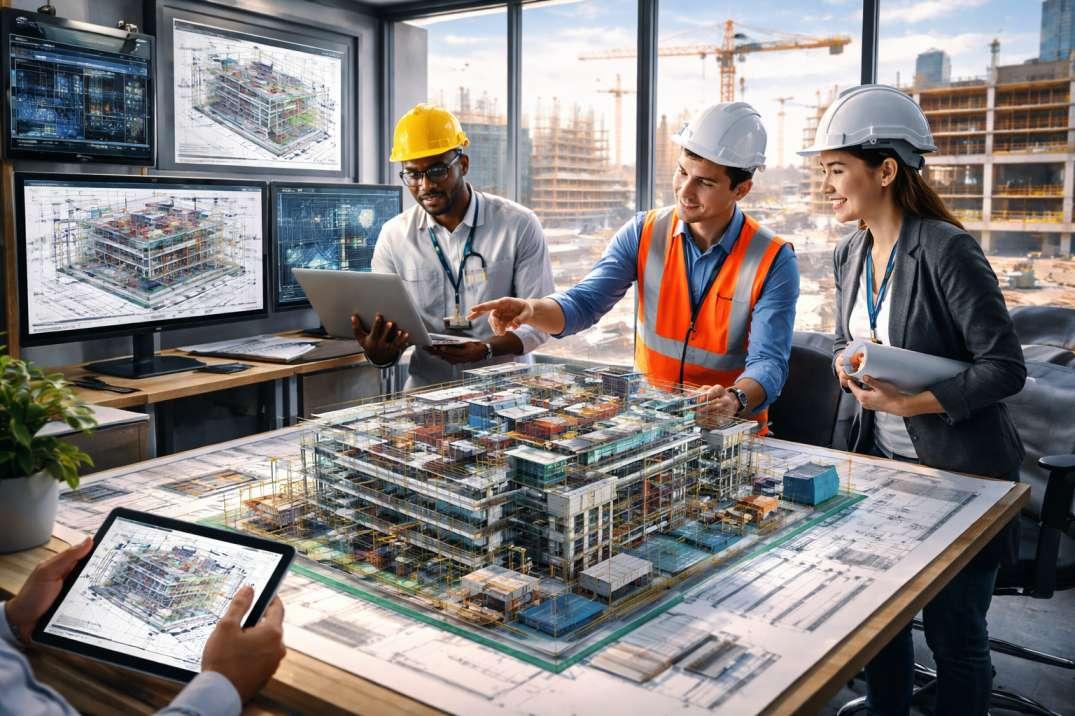
One technology that has become central to this transformation is Revit 3D Modeling Services. Built around Building Information Modeling (BIM), Revit enables professionals to create intelligent 3D models that support collaboration, improve communication, and reduce project risks.
Across the UK, the USA, and global construction markets, organizations are increasingly adopting Revit-based workflows to streamline project coordination.
For business owners, startups, architects, engineers, and technology decision-makers, understanding the role of Revit in BIM collaboration can help unlock new opportunities for productivity, innovation, and cost efficiency.
Revit 3D Modeling Services involve creating intelligent three-dimensional digital models of buildings and infrastructure using Autodesk Revit software. Unlike traditional CAD models that focus primarily on geometry, Revit models contain detailed information about building components.
These models can include data related to:
Architectural elements
Structural components
Mechanical, electrical, and plumbing systems
Materials and construction details
Project timelines and cost information
Because Revit models are data-rich, they allow teams to collaborate more effectively throughout the design and construction process.
Many companies combine Architectural BIM Modelling Services with advanced digital workflows to create integrated models that support project planning, design development, and facility management.
Modern construction projects often involve dozens of professionals from different disciplines working simultaneously. Without proper coordination, these teams may encounter design conflicts, communication gaps, and costly delays.
BIM collaboration solves this problem by allowing project stakeholders to work within a shared digital model.
Instead of exchanging separate drawings, teams collaborate through a centralized BIM environment where design updates can be shared instantly.
According to research published by Autodesk on BIM adoption in construction, digital collaboration tools significantly improve project efficiency and reduce errors in design and documentation.
This collaborative approach has made BIM a key driver of digital transformation in the global construction industry.
One of the biggest advantages of Revit 3D Modeling Services is the creation of a centralized digital model that can be accessed by multiple project teams.
This model acts as a single source of truth for all design information.
With a centralized model, teams can:
View real-time design updates
Identify conflicts between building systems
Ensure consistency across design disciplines
This improves transparency and ensures that everyone works from the same set of project data.
Construction projects typically involve architects, structural engineers, MEP engineers, contractors, and consultants.
Each team focuses on a different aspect of the design.
Using shared Revit models, teams can easily understand how their work interacts with other systems in the building.
For example:
Structural engineers can review architectural layouts.
Mechanical designers can coordinate HVAC systems with structural components.
Contractors can plan construction sequences more efficiently.
This integrated communication significantly improves project coordination.
Architectural BIM Modelling Services extend the benefits of 3D modeling by integrating design data directly into the model.
Unlike standard 3D drawings, BIM models store detailed information about each building component.
This allows project teams to:
Track material specifications
Analyze building performance
Estimate project costs
Manage construction schedules
By linking data with geometry, BIM enables smarter design decisions throughout the project lifecycle.
Research from McKinsey on digital construction technologies suggests that BIM and digital modeling can improve productivity in construction by enabling better planning and coordination.
Clash detection is one of the most valuable benefits of BIM-based modeling.
In complex construction projects, different building systems often compete for the same physical space.
For example:
HVAC ducts may interfere with structural beams
Plumbing lines may conflict with electrical conduits
Structural supports may block mechanical systems
With Revit 3D Modeling Services, these conflicts can be detected during the design phase.
Early clash detection helps teams:
Avoid costly on-site rework
Reduce construction delays
Improve design accuracy
This proactive approach significantly lowers project risks.
While Revit focuses on BIM-based modeling, 3D CAD Modeling Services still play an important role in many design processes.
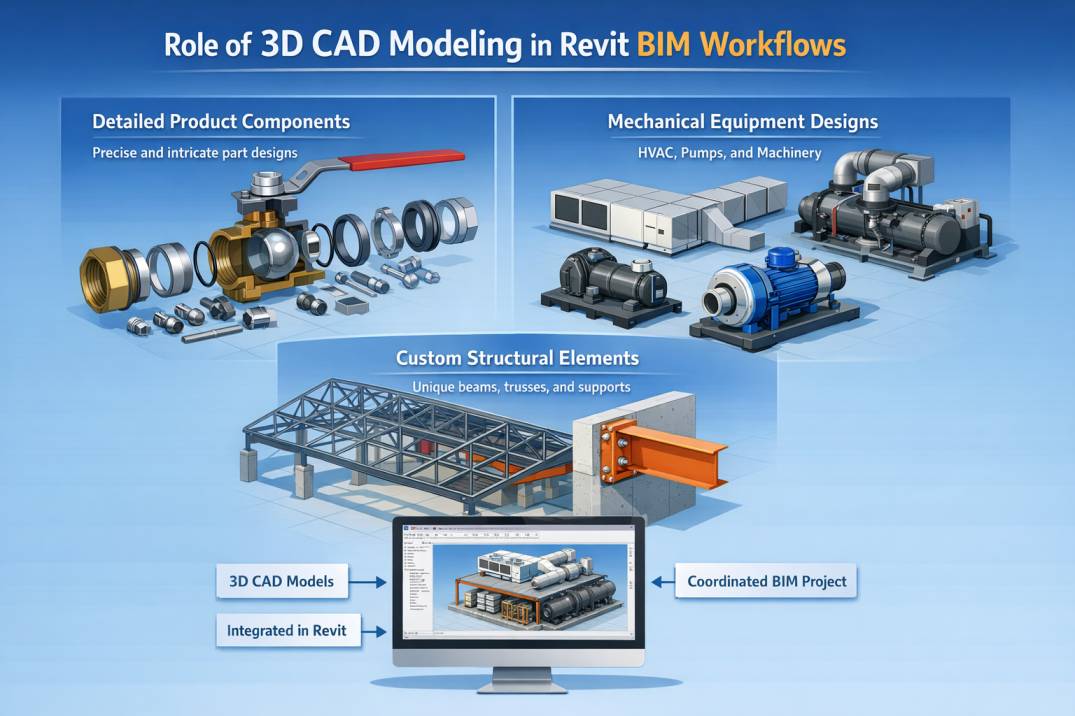
CAD models are often used for:
Detailed product components
Mechanical equipment designs
Custom structural elements
These models can be integrated into Revit environments, allowing project teams to combine CAD-based geometry with BIM-based data.
This integration creates a more comprehensive digital design ecosystem.
Every construction project has unique design requirements. Some buildings feature complex geometries, specialized systems, or unique architectural elements that require custom modeling solutions.
Custom 3D Modelling Services allow designers to create tailored digital models that accurately represent these complex structures.
Custom modeling supports:
Innovative architectural designs
Specialized building systems
Advanced facade structures
Complex engineering components
By adapting digital models to specific project needs, custom modeling enhances both design flexibility and technical precision.
3D CAD Solid Modelling Services are commonly used in engineering applications where detailed component modeling is required.
Solid modeling enables engineers to represent objects with precise geometry and physical properties.
This type of modeling is especially useful for:
Structural components
Mechanical assemblies
Industrial equipment
When integrated with BIM environments, solid models help ensure that engineering components fit seamlessly into building designs.
The CAD design and drafting industry is evolving rapidly as new technologies enhance digital design workflows.
Several trends are shaping the future of 3D Modelling Services and BIM collaboration.
Cloud platforms allow project teams to access models from anywhere in the world.
This is particularly valuable for global firms managing projects across multiple regions.
AI-powered design tools are beginning to automate repetitive tasks such as clash detection and design optimization.
These tools help engineers identify potential design improvements faster.
Architects and developers can now explore BIM models using immersive VR environments.
This technology helps stakeholders visualize building designs before construction begins.
Digital twins create virtual replicas of buildings that continue to update throughout the building lifecycle.
These models support facility management and predictive maintenance.
Developing detailed BIM models requires specialized expertise and technical knowledge.
For this reason, many organizations partner with an experienced 3D Modeling Company to support their design workflows.
Working with professional modeling providers offers several advantages:
Access to skilled BIM specialists
Faster project turnaround
Improved model accuracy
Scalable support for large projects
These benefits help companies manage complex projects more efficiently.
Organizations that rely solely on traditional drafting methods often face significant coordination challenges.
Common issues include:
Design conflicts between building systems
Communication gaps between project teams
Delays caused by design revisions
Increased construction costs due to rework
Without BIM-based collaboration, managing complex construction projects becomes far more difficult.
As construction projects become more technologically advanced, Revit 3D Modeling Services are playing a crucial role in improving BIM collaboration across the architecture, engineering, and construction industries.
By combining Architectural BIM Modelling Services, 3D CAD Solid Modelling Services, and advanced Custom 3D Modelling Services, organizations can create highly detailed digital models that support smarter design decisions and more efficient project coordination.
Across markets such as the UK and the USA, many architecture and engineering firms partner with experienced modeling providers to enhance their BIM workflows. In many cases, collaborating with a reliable UK-based CAD drafting and design company helps organizations scale their design capabilities while maintaining high levels of accuracy and collaboration.
As digital construction technologies continue to evolve, Revit-based modeling will remain a powerful tool for improving efficiency, reducing project risks, and shaping the future of modern construction.
Revit 3D Modeling Architectural BIM Modelling Services 3D Modelling Services


