Notifications

5 minutes, 52 seconds
-5 Views 0 Comments 0 Likes 0 Reviews
In today’s subscription-driven economy, access has replaced ownership as the dominant business model. From SaaS platforms to recurring product deliveries, subscription models now power predictable and scalable revenue streams. However, as subscription businesses grow, operational complexity increases. Finance teams must handle recurring invoices, mid-cycle upgrades and downgrades, proration calculations, and revenue recognition adjustments. While Sage Intacct provides a strong financial management foundation, managing high volumes of recurring billing directly within an accounting system can become time-consuming and manually intensive without specialized automation.
Recurring billing refers to the automated process of charging customers at predefined intervals, such as monthly, annually, or based on usage. Instead of creating invoices manually for each billing cycle, the system generates invoices, processes payments, updates subscription statuses, and records financial transactions automatically. This structure ensures steady cash flow, reduces administrative workload, and improves consistency in financial reporting. Different billing models introduce varying levels of complexity, particularly when customers modify their subscriptions mid-cycle.
Sage Intacct is a cloud-based financial management system that delivers core accounting capabilities including general ledger, accounts payable, accounts receivable, and cash management. It also offers AI-driven tools that support anomaly detection, financial insights, and streamlined month-end closing processes. Its dimensional reporting enables analysis by department, location, or project, while multi-entity management allows seamless consolidation. As a cloud-native platform, it integrates efficiently with other systems through APIs, making it suitable for scaling organizations.
Despite its strengths, managing subscription billing entirely within Sage Intacct can create operational challenges. Finance teams often need to manually configure billing schedules, adjust contracts during plan upgrades or downgrades, and calculate proration amounts. Mid-cycle changes frequently require manual updates to revenue recognition schedules, which can slow month-end closing and increase reporting risks. As subscription volume grows, these manual processes can become bottlenecks that impact accuracy and efficiency.
Subscription businesses benefit from implementing a specialized recurring billing solution alongside their accounting system. A dedicated platform automates invoice generation, tax calculations, renewal management, and proration handling. It also supports automated payment retries and dunning processes to reduce churn. In addition, subscription-focused platforms provide deeper insights such as monthly recurring revenue tracking, churn analysis, customer lifetime value, and cohort reporting, enabling better strategic decision-making.
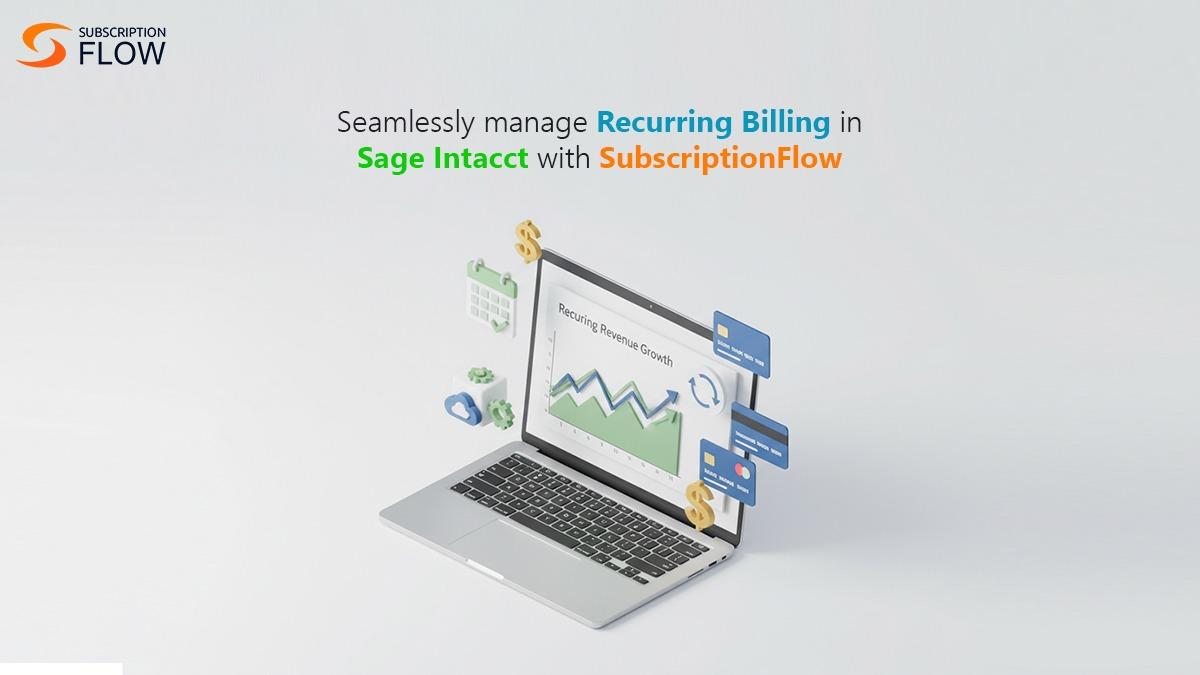
Integrating SubscriptionFlow with Sage Intacct creates a balanced ecosystem where each system performs its core function efficiently. SubscriptionFlow manages subscription creation, billing automation, plan changes, and customer lifecycle events, while Sage Intacct focuses on financial reporting and revenue recognition. Automated invoice synchronization eliminates manual data entry, ensures real-time financial data flow, and reduces reconciliation efforts. This integration significantly decreases repetitive accounting tasks and allows finance teams to concentrate on forecasting and strategic planning.
The integration typically begins with creating subscription plans within SubscriptionFlow and automating recurring invoice generation. These invoices synchronize directly with Sage Intacct, where revenue recognition policies are applied in compliance with accounting standards. Payments are tracked and reconciled within the accounting system, ensuring financial transparency and audit readiness. This streamlined workflow improves operational efficiency and financial accuracy.
By combining subscription automation with financial management, organizations achieve faster month-end closes, improved billing accuracy, and reduced manual reconciliation. Automation minimizes revenue leakage, lowers dispute rates, and strengthens compliance with revenue recognition standards. As subscription volume increases, automated systems absorb transaction loads without requiring additional finance headcount, supporting scalable growth.
To maximize efficiency, businesses should automate billing workflows wherever possible and ensure subscription logic aligns with accounting policies. Monitoring metrics such as churn and monthly recurring revenue alongside financial reporting provides complete visibility into business performance. Maintaining clean and accurate system integration ensures reliable data synchronization and informed decision-making.
Managing recurring billing in Sage Intacct does not have to be a manual burden. By combining strong financial management with advanced subscription automation through SubscriptionFlow, businesses can transform recurring revenue operations into a scalable growth engine. This approach enhances billing precision, reduces administrative workload, strengthens compliance, and supports sustainable long-term expansion.
Recurring billing Sage Intacct integration subscription management software subscription accounting SaaS billing automation revenue recognition


