Notifications

18 minutes, 36 seconds
-30 Views 0 Comments 0 Likes 0 Reviews
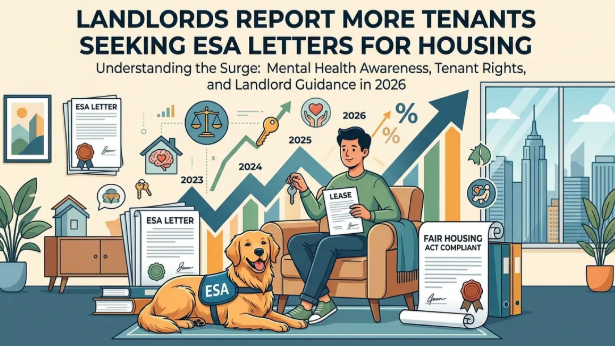
Rental offices across the United States are fielding more accommodation requests tied to emotional support animals than ever before. Property managers in major metro areas from Texas to New York report that ESA letter submissions now arrive with nearly every competitive lease cycle, a pattern that has intensified noticeably since 2023. For landlords, this shift changes how they process tenant applications. For renters, it signals a growing awareness of federal housing rights that many Americans never knew they had.
This trend reflects both a rising national conversation around mental health and a sharp increase in tenants who understand how the Fair Housing Act protects them. Understanding why this surge is happening, what it means for both parties, and how to navigate it correctly in 2026 has become essential knowledge for anyone renting property in the United States today.
The growth in ESA letter for housing requests stems from several converging forces. Post-pandemic mental health awareness pushed millions of Americans into therapy and telehealth consultations, where licensed professionals introduced the concept of emotional support animals as a recognized treatment tool. Simultaneously, the expansion of online platforms connecting renters with licensed mental health professionals made obtaining legitimate documentation far more accessible than it was even five years ago.
Rising rental costs also play a role. With average pet deposits ranging from $300 to $800 or more in major cities, the financial motivation to understand ESA housing rights has grown significantly. Tenants who previously paid these fees without question are now learning that a legitimate ESA letter for housing eliminates pet fees, pet deposits, and breed or size restrictions under federal law. In a market where every dollar counts, that protection is meaningful and worth pursuing through proper channels.
Mental health awareness campaigns have also destigmatized the conversation around qualifying conditions. Conditions like anxiety, depression, PTSD, ADHD, and bipolar disorder, which were once rarely discussed openly, now appear in everyday conversation. When tenants learn that these documented conditions may qualify them for an emotional support animal under the Fair Housing Act, accommodation requests naturally follow.
Landlords navigating this trend must understand the clear legal framework governing ESA housing accommodations. The Fair Housing Act emotional support animal protections require housing providers to grant reasonable accommodations to tenants with qualifying disabilities, even in properties with strict no-pet policies. This obligation applies to most landlords, property management companies, HOAs, and housing providers nationwide.
When a tenant presents a valid ESA letter for housing, property managers cannot legally:
The HUD Notice FHEO-2020–01 clarified the verification standards landlords may use when evaluating accommodation requests. Landlords can request reliable documentation confirming a disability-related need when it is not obvious. They cannot, however, demand detailed medical records, require specific diagnoses, or impose unreasonable documentation standards that effectively deny legitimate tenants their rights.
Understanding these boundaries protects both parties. Landlords who respond appropriately to valid documentation stay compliant with federal law and avoid costly fair housing complaints. Tenants who obtain proper letters from licensed professionals ensure their requests hold up to verification scrutiny.
As ESA requests have increased, so has landlord sophistication about documentation quality. Property managers in high-volume rental markets have become more adept at distinguishing legitimate letters from the counterfeit “certifications” and “registrations” sold by fraudulent online platforms.
A legitimate ESA letter must include several essential elements to satisfy landlord verification requirements and withstand legal scrutiny:
Letters missing any of these elements give landlords legal grounds to request additional documentation or to question validity. This is precisely why the source of an ESA letter matters as much as the letter itself. Generic certificates, “ESA registration” documents, and instant-approval forms carry no legal weight and can lead to rejection during the verification process.
Landlords now routinely call the issuing therapist’s office to confirm the letter’s authenticity. This verification step means tenants need letters backed by real licensed professionals who remain reachable for landlord follow-up calls or emails.
The surge in ESA requests has an unfortunate shadow side. As more tenants have sought documentation, fraudulent websites have proliferated to meet demand with cheap, fast, and legally worthless letters. These platforms sell “certifications” and “registrations” that do not involve any licensed mental health professional and carry zero legal protection under the Fair Housing Act.
When tenants present these fake documents, several problems follow. Landlords who detect fraudulent letters gain legal grounds to reject the accommodation request outright. Tenants lose their deposit, face lease delays, and may lose access to housing they desperately need. In states like California and Texas, presenting fraudulent ESA documentation can expose tenants to civil penalties under recently tightened state laws.
This fraud problem has also made some legitimate requests harder to process. Landlords who have encountered fake letters understandably exercise more scrutiny across all requests, adding verification steps that slow down approval timelines even for tenants with entirely legitimate documentation from licensed professionals.
The solution for tenants lies in understanding what constitutes a real vs. fake ESA letter before making any investment. A legitimate letter always involves a licensed mental health professional who evaluates your specific need and issues documentation tied to an established therapeutic relationship. Any platform promising instant approval without a clinical assessment is not providing a letter that meets HUD standards.
One area where landlords frequently make compliance errors involves what questions they may legally ask a tenant presenting an ESA request. HUD guidelines draw a clear line between permissible verification and unlawful intrusion into a tenant’s medical privacy.
Landlords can legally ask for:
Landlords cannot legally ask for:
Property managers who cross these lines risk fair housing violations carrying significant financial penalties. As ESA requests become more routine, training leasing staff on proper verification procedures has become a practical priority for property management companies nationwide.
When a landlord denies an ESA request improperly, tenants have the right to file a complaint with HUD, pursue legal remedies through fair housing organizations, or seek mediation. Reputable ESA letter providers support tenants through this process, including offering refunds if a properly issued letter is denied without legal justification.
The national increase in ESA housing requests is not uniform across all states. High-cost rental markets and states with strong tenant protection frameworks show the sharpest increases. California, New York, Texas, and Florida account for a disproportionate share of both ESA accommodation requests and fair housing complaints related to ESA denials.
California added specific compliance requirements through AB-468 in 2022, requiring telehealth providers to establish a 30-day client-provider relationship before issuing an ESA letter. This law was designed to curb fraudulent letter mills while preserving access for tenants with genuine needs. Texas passed HB 4164, which established penalties for tenants who fraudulently misrepresent ESA documentation to housing providers. These legislative responses signal that state governments are paying attention to both tenant rights and landlord concerns simultaneously.
For tenants in states with stricter requirements, working with a provider that explicitly complies with state-specific ESA laws matters enormously. A letter issued without regard for state compliance requirements may not hold up to landlord scrutiny even if it would satisfy basic federal standards in other states.
For tenants who believe they qualify for an emotional support animal accommodation, the process of obtaining a legitimate letter has become streamlined and accessible in 2026. Licensed telehealth platforms now connect tenants with state-licensed mental health professionals through secure online assessments, eliminating the need for in-person appointments while maintaining full legal compliance.
The standard process through a compliant provider involves completing a clinical questionnaire, connecting with a licensed therapist who reviews your responses and evaluates your need, and receiving a HIPAA-compliant PDF letter within 24 to 48 hours after approval. For states with 30-day relationship requirements, compliant providers extend the process accordingly to ensure the resulting letter meets all applicable legal standards.
ESA letter pricing through RealESALetter.com starts at $149 for a housing letter valid for 12 months, with same-day PDF delivery available after therapist approval. The ESA Letter plus PSD Combo is available at $199 for tenants who may also need psychiatric service dog documentation for additional purposes. All letters come with a 100% money-back guarantee if the tenant does not qualify or if the letter is improperly rejected after proper verification steps.
Tenants should look for providers that offer landlord verification support, meaning the issuing therapist or a support team member is available to confirm letter authenticity by phone or email when property managers conduct verification calls. This feature alone resolves the majority of landlord hesitations about ESA accommodation requests in 2026.
As landlords apply more thorough verification processes, tenants benefit from understanding how to present their ESA documentation professionally and effectively. Approaching the conversation proactively rather than reactively tends to produce faster approvals and fewer complications during lease negotiations.
Consider these practical submission strategies:
Tenants who approach ESA accommodation requests with organized, compliant documentation from licensed providers consistently report smoother approval experiences than those who present questionable letters or arrive unprepared for landlord verification questions.
Q1: Do landlords have to accept an ESA letter from a telehealth provider?
Yes, as long as the letter meets HUD standards, a telehealth-issued letter carries the same legal weight as one issued after an in-person appointment. The Fair Housing Act evaluates the letter’s content and the therapist’s licensing credentials, not the delivery method.
Q2: Can a landlord charge a pet deposit for an emotional support animal?
No. Under the Fair Housing Act, landlords cannot charge pet fees, pet deposits, or monthly pet rent for a properly documented ESA. The animal is classified as an accommodation, not a pet.
Q3: What happens if my ESA letter is rejected by my landlord?
If your landlord improperly rejects a legitimate ESA letter, you can file a fair housing complaint with HUD. Reputable providers like RealESALetter.com offer refunds if your letter is rejected without legal justification after proper verification steps.
Q4: How often do I need to renew my ESA letter for housing?
Most ESA letters for housing remain valid for 12 months from issuance. Annual renewal keeps your documentation current and ensures continued housing protection without gaps during lease renewals or new applications.
Q5: What conditions qualify someone for an ESA letter for housing?
Qualifying conditions include anxiety, depression, PTSD, ADHD, bipolar disorder, OCD, insomnia, panic disorder, and other documented mental or emotional disabilities. A licensed mental health professional determines eligibility based on a clinical assessment, not a self-reported checklist.
The steady increase in tenants seeking an ESA letter for housing reflects a broader national trend toward mental health awareness, tenant rights education, and telehealth accessibility. For landlords, this trend demands clear policies, compliant verification practices, and staff training on fair housing obligations. For tenants, it underscores the importance of obtaining documentation from licensed professionals who produce letters capable of withstanding landlord scrutiny.
Navigating this landscape successfully in 2026 starts with understanding your rights, obtaining compliant documentation from a trusted source, and presenting your accommodation request professionally. Tenants who approach this process with legitimate letters from state-licensed therapists consistently secure the housing protection they need without unnecessary delays or complications.


