Notifications

8 minutes, 45 seconds
-64 Views 0 Comments 0 Likes 0 Reviews
In today’s demanding healthcare landscape, patients expect quick, accurate, and compassionate responses to every inquiry. Healthcare Call Center Services handle appointment scheduling, medical billing questions, telehealth support, and urgent patient needs around the clock. Yet many providers struggle with high call volumes, staffing shortages, and strict regulations.
This is why more organizations now explore medical call center outsourcing as a strategic solution. By partnering with specialized teams, providers free up internal staff to focus on core clinical work while delivering seamless patient experiences. However, outsourcing healthcare call centers also brings challenges related to control, data security, and service quality.
Healthcare Call Center Services manage inbound and outbound patient communications for clinics, hospitals, and health systems. Agents handle tasks such as patient appointment scheduling, prescription refill requests, insurance verification, and post-discharge follow-ups.
Modern services also support telehealth support services, symptom triage, and multilingual assistance. Providers rely on these services to maintain continuous patient engagement while meeting regulatory standards like HIPAA.
The global healthcare BPO market reached $417.7 billion in 2025 and is projected to hit $694.3 billion by 2030, growing at a 10.7% CAGR. Providers turn to medical call center outsourcing to handle surging demand from aging populations and expanding telehealth options.
Additionally, 57% of companies outsource to focus on core business functions, according to Deloitte research. In healthcare, this shift allows teams to prioritize direct patient care over routine call management. Moreover, AI adoption in contact centers continues to rise, with 52% already investing in conversational tools that boost efficiency.
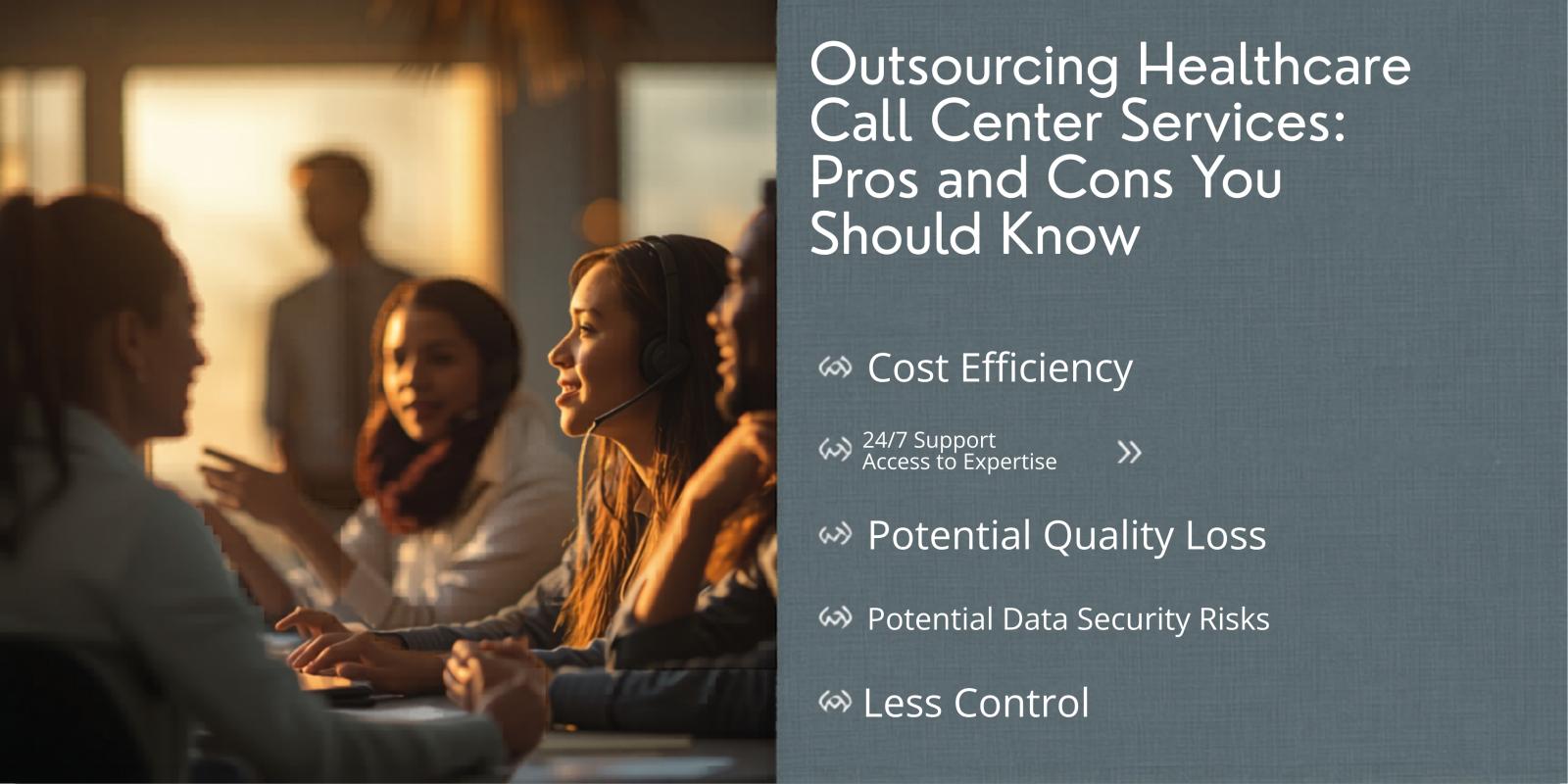
Outsourcing healthcare call centers delivers several powerful benefits when executed well. Here are the key advantages:
Access to specialized expertise: Trained agents understand complex medical terminology, insurance rules, and patient privacy protocols better than general staff.
Scalability during peak times: Providers easily handle flu seasons, open enrollment surges, or telehealth spikes without hiring full-time employees.
24/7 patient support: Round-the-clock coverage improves access and reduces missed calls for urgent inquiries.
Improved patient experience: Dedicated teams often achieve higher first-call resolution and satisfaction scores through focused training.
Real-world example: A global pharmaceutical company outsourced patient support programs and maintained 96%+ satisfaction rates while assisting over 514,000 unique patients across 18+ years. This demonstrates how medical call center outsourcing can deliver consistent, high-quality care at scale.
Furthermore, outsourcing healthcare call centers integrates advanced tools like AI routing and omnichannel platforms, which streamline workflows and enhance patient engagement services.
Despite clear benefits, outsourcing healthcare call center services carries notable risks. Organizations must weigh these carefully:
Reduced direct control: Internal teams lose some oversight of daily processes, scripts, and tone, which can affect brand consistency.
Data security concerns: Handling protected health information requires ironclad safeguards; any lapse risks compliance violations.
Integration challenges: Aligning outsourced systems with existing EHR platforms or internal protocols takes time and coordination.
Potential quality variations: Not every partner delivers the same clinical knowledge or cultural sensitivity.
However, providers mitigate these cons by selecting HIPAA compliant healthcare call centers and maintaining strong vendor oversight. For instance, one U.S. healthcare transport provider faced high abandonment rates before switching partners. After rapid integration for medical call center outsourcing, they reduced call abandonment by 68%, boosted first-call resolution by 52%, and cut average response time by 47%.
The industry evolves quickly. Here are five numbered trends driving medical call center outsourcing:
AI and automation integration – Agentic AI is expected to resolve up to 80% of routine issues by 2029, freeing agents for complex patient needs.
Omnichannel patient support – Calls now blend with SMS, chat, and video for seamless telehealth support services.
HIPAA compliant healthcare call centers – Strict data protocols and business associate agreements remain non-negotiable.
Remote and virtual agents – Cloud platforms enable secure, location-flexible teams that scale instantly.
Proactive patient engagement services – Outbound campaigns reduce no-shows and improve preventive care follow-through.
These trends show why forward-thinking providers invest in modern outsourcing healthcare call centers.
|
Trend |
Benefit to Providers |
Impact on Patients |
|
AI Automation |
Handles routine queries faster |
Quicker responses, less wait time |
|
Omnichannel Support |
Unified patient records across channels |
Convenient, consistent communication |
|
HIPAA Compliance |
Built-in security and audit trails |
Greater trust and privacy protection |
|
24/7 Virtual Teams |
No coverage gaps during off-hours |
Always-available support |
Choose partners wisely. First, verify they operate as HIPAA compliant healthcare call centers and sign proper business associate agreements. Second, request detailed training records and sample call scripts. Third, conduct regular performance audits and patient feedback surveys.
Additionally, start with a pilot program for patient appointment scheduling or billing inquiries before full rollout. These steps help maximize benefits while minimizing risks in outsourcing healthcare call center services.
What are the main advantages of outsourcing healthcare call center services?
Outsourcing delivers scalability, 24/7 patient support, and specialized medical expertise. Providers focus on clinical care while experienced teams handle calls efficiently.
How does medical call center outsourcing impact HIPAA compliance?
Reputable partners maintain full HIPAA compliant healthcare call centers with secure systems, staff training, and audit-ready processes. Always review business associate agreements.
Can outsourcing healthcare call centers improve patient appointment scheduling?
Yes. Dedicated teams reduce no-shows through timely reminders and easy booking, enhancing overall patient engagement services.
What should providers look for in telehealth support services?
Seek partners experienced in virtual visit assistance, multilingual support, and seamless EHR integration for smooth patient experiences.
Outsourcing healthcare call center services offers clear paths to greater efficiency, better patient access, and stronger focus on core medical care. While challenges around control and compliance exist, thoughtful selection of HIPAA compliant healthcare call centers turns potential drawbacks into manageable details.
Real examples prove that medical call center outsourcing can dramatically improve satisfaction scores and operational flow. As trends like AI and omnichannel support accelerate in 2026, now is the ideal time to evaluate your options.
Review official guidelines from the U.S. Department of Health and Human Services on HIPAA compliance to strengthen your decision-making. Take the next step today—assess your current call volume, map patient needs, and explore how modern healthcare call center services can elevate care delivery for your organization. Your patients—and your team—will thank you.
Healthcare Contact Centers healthcare call center services healthcare call center outsourcing


