Notifications

9 minutes, 7 seconds
-4 Views 0 Comments 0 Likes 0 Reviews
Every few years, something comes along in the tech world that changes how developers build things. Not in a dramatic overnight way but gradually, quietly, until one day you look around and realise most people have already moved on to the new approach.
Serverless architecture is one of those shifts.
It has been growing steadily for a few years now, and in 2026, it is no longer just something big tech companies experiment with. Businesses of all sizes are building web applications using serverless technology, and the reasons why are pretty straightforward once you understand what it actually means.
What Are Serverless Web Applications?
The name is a little misleading, so let us clear that up first.
Serverless does not mean there are no servers. There are always servers somewhere. What it means is that you, as a business owner or developer, do not have to think about them. You do not set them up, maintain them, update them, or worry about them going down at two in the morning.
Instead, you write your code, upload it to a platform, and it runs when it needs to. You only pay for the exact moments your application is actually being used. When nobody is using it, you are not paying for anything sitting idle.
Think of it like electricity. You do not own a power plant to keep your lights on. You just use electricity when you need it and pay for what you use. Serverless works the same way for software.
Why Businesses Are Moving in This Direction
The old way of building web applications meant you had to estimate how much traffic your app would get and then set up servers big enough to handle that. Get it wrong, and your app crashes when too many people use it. Or you overpay for servers that are mostly sitting empty.
Serverless removes that problem completely.
If ten people use your app today and ten thousand use it tomorrow, the platform handles that automatically. It scales up when needed and scales back down when things are quiet. You never have to lift a finger.
For startups and growing businesses, this is a big deal. You are not spending money on infrastructure you do not need yet. You build, you launch, and you grow without having to stop and rethink your entire setup every time your user numbers change.
Deployment also gets faster. Developers spend less time managing servers and more time building features. That speed matters a lot when you are trying to move quickly in a competitive market.
How Serverless Supports Modern Web Development
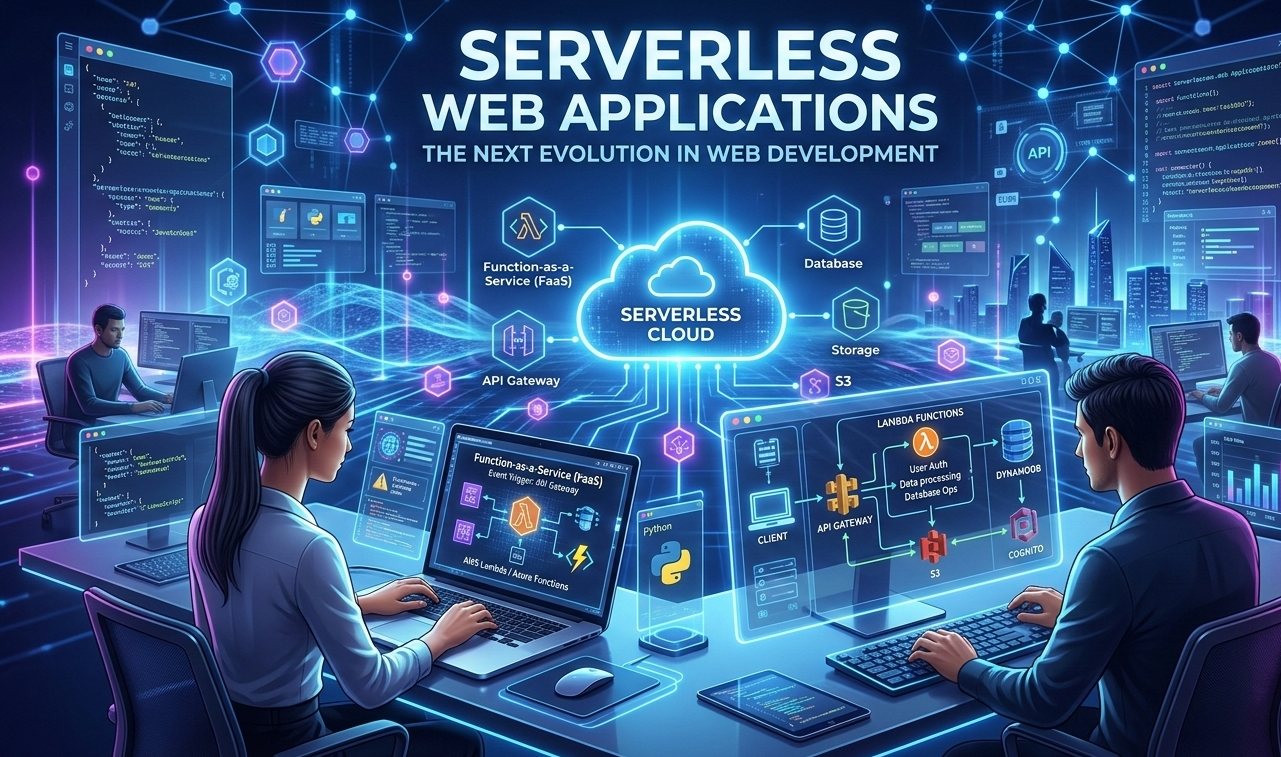
Serverless platforms like AWS Lambda, Google Cloud Functions, and Azure Functions have made it genuinely practical for development teams to build complex web applications without the traditional infrastructure headaches.
Each piece of your application runs independently. The part that handles user logins does its job. The part that processes payments does its job. They do not interfere with each other, and if one part has an issue, the rest of the application keeps running.
This approach also makes it easier to update specific parts of an application without touching everything else. That means fewer risks, faster updates, and a more reliable experience for the people actually using the app.
What Is Happening With This in the USA
The adoption of serverless technology has been particularly strong across the United States, where businesses are always looking for ways to move faster and spend smarter.
Start-ups, especially, have taken to it quickly because it lets a small team build and launch something solid without needing a large infrastructure budget upfront. But it is not just start-ups. Established companies in retail, finance, healthcare, and media have all been rebuilding parts of their platforms using serverless because the efficiency gains are hard to ignore.
For teams working in web application development in USA the shift toward serverless has also changed what clients expect. Faster launches, lower running costs, and apps that can handle sudden spikes in traffic without breaking are no longer nice to have. They are standard expectations.
Many businesses that previously relied on traditional hosting setups are now working with development partners who specialise in serverless architecture because the results speak for themselves.
Real Benefits for Businesses
Reduced costs is the obvious one. But beyond that, there is something less talked about, which is peace of mind.
When you are not managing servers, you are not getting woken up at midnight because something crashed. You are not scrambling to upgrade infrastructure before a big product launch. The platform handles all of that, so your team can focus on building things that actually matter to your customers.
Performance also tends to improve. Serverless applications are designed to respond quickly and handle load efficiently. For users, that means faster load times and a smoother experience, which directly affects how they feel about your product.
And innovation speeds up. When developers are not bogged down in infrastructure work, they spend more time solving real problems and building features users actually want. That creative energy is where the real value comes from.
Where Is This All Going?
Serverless is not going to replace every type of web application. Some projects genuinely need more control over the underlying infrastructure, and that is fine.
But for a growing number of use cases, serverless is simply the smarter choice. As the tools improve and more developers become comfortable with the approach, it will become the default way many teams build web applications.
AI is also starting to integrate with serverless platforms in interesting ways. Functions that trigger automatically based on user behaviour, personalised experiences that adjust in real time, and background processes that run intelligently without any manual oversight. These capabilities are becoming more accessible, and serverless architecture is a big part of what makes them practical.
Businesses that understand this now and start building with serverless in mind are going to have a real advantage as these technologies mature.
Conclusion
Serverless web applications represent a genuine step forward in how software gets built and run. Less infrastructure to worry about, lower costs, faster development, and applications that scale without any extra effort.
For businesses focused on web application development in the USA and beyond, the message is pretty clear. The old way of managing your own servers and paying for capacity you may never use is becoming harder to justify when better options exist.
The next evolution in web development is already here. The businesses building on it today are the ones that will find it easiest to grow tomorrow.
web application development in USA serverless web applications modern web application development future of web development