Notifications

10 minutes, 40 seconds
-5 Views 0 Comments 0 Likes 0 Reviews
Human resources departments across the world are undergoing a fundamental transformation driven by digitalization, workforce globalization, and evolving employee expectations. At the center of this transformation lies the Core HR Software Market, which is rapidly emerging as the operational backbone of modern workforce management systems.
Core HR software provides organizations with centralized platforms to manage employee data, payroll integration, benefits administration, compliance requirements, workforce analytics, and performance tracking. As businesses increasingly prioritize efficiency, automation, and data-driven decision-making, the demand for advanced HR management systems continues to rise.
Organizations are no longer viewing HR software merely as an administrative tool. Instead, it has become a strategic platform enabling talent management, workforce planning, employee engagement, and organizational intelligence.
The growing adoption of cloud computing, artificial intelligence, and workforce analytics technologies is significantly accelerating market expansion.
Core HR software refers to a centralized digital platform designed to manage and automate essential human resource functions across an organization. These platforms serve as a single source of truth for employee-related information and HR operations.
Key capabilities typically include:
• Employee data management
• Payroll and compensation management
• Benefits administration
• Time and attendance tracking
• Compliance and regulatory reporting
• Workforce analytics and reporting
• Organizational structure management
Unlike traditional HR tools, modern core HR systems integrate with broader HR technology ecosystems such as talent acquisition platforms, learning management systems, and employee experience tools.
The primary objective is to streamline HR processes while improving workforce visibility and decision-making capabilities.
Large enterprises, small businesses, and public sector organizations are increasingly implementing these platforms to modernize workforce management.
The development of the core HR software market reflects the broader evolution of enterprise software solutions.
Initially, HR management relied on manual documentation and spreadsheets. Early software solutions focused primarily on payroll processing and employee record management.
With the rise of enterprise resource planning systems in the late 1990s and early 2000s, HR modules became integrated within larger enterprise systems. This allowed organizations to manage HR operations alongside finance, procurement, and operations.
The introduction of cloud computing transformed HR technology by enabling scalable, subscription-based HR platforms accessible from anywhere. Cloud deployment significantly reduced infrastructure costs while improving accessibility and flexibility.
Today’s core HR platforms incorporate artificial intelligence, machine learning, automation, and predictive analytics. These technologies help organizations anticipate workforce trends, optimize talent strategies, and enhance employee experiences.
Organizations across industries are modernizing HR departments through digital transformation initiatives. Automated HR platforms reduce manual workloads and improve operational efficiency.
The global shift toward remote and hybrid work environments has increased demand for centralized HR systems capable of managing distributed workforces.
Modern organizations require deeper insights into employee performance, retention patterns, and workforce productivity. Core HR software provides advanced analytics that enable data-driven decision-making.
Labor regulations and compliance requirements continue to evolve globally. HR platforms simplify regulatory reporting and ensure organizations remain compliant with employment laws.
Large-scale HR system deployments can require significant planning, customization, and integration with existing enterprise systems.
HR systems manage highly sensitive employee data, making cybersecurity and privacy protection critical concerns for organizations.
Adopting new HR technology often requires cultural shifts within organizations, including employee training and operational restructuring.
Artificial intelligence is transforming HR software by enabling predictive workforce insights. AI-powered platforms can analyze employee behavior patterns, predict turnover risks, and recommend talent management strategies.
Organizations are increasingly integrating HR software with employee experience platforms that enhance engagement, communication, and collaboration.
Mobile accessibility has become a critical feature of modern HR systems. Employees can now access HR services, submit leave requests, track performance goals, and receive updates directly from mobile applications.
Automation tools allow employees and managers to perform routine HR tasks through self-service portals. This reduces HR administrative workloads while improving operational efficiency.
Core HR software is increasingly integrated with recruitment platforms, learning management systems, performance management tools, and workforce planning solutions.
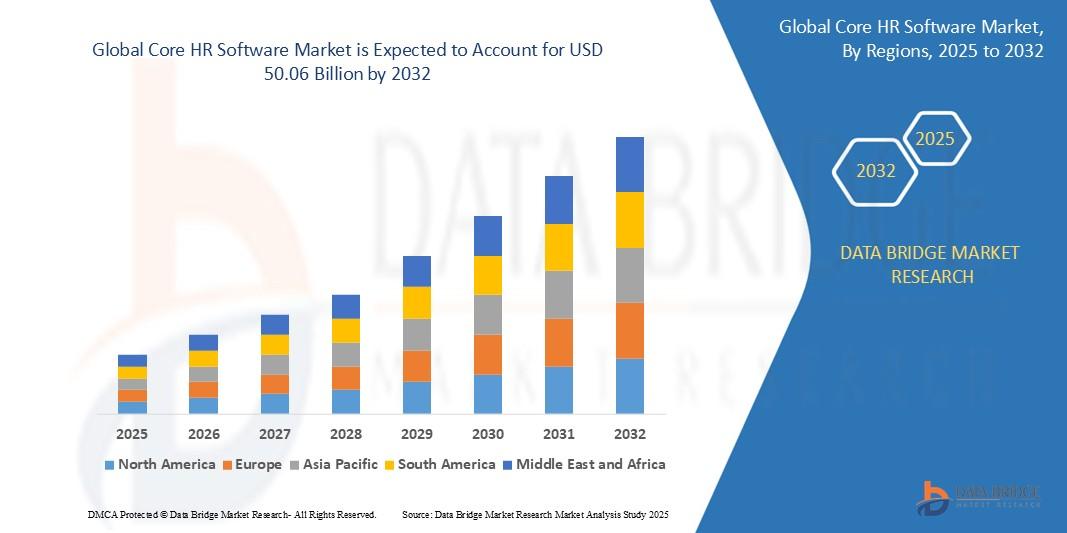
North America remains the largest market for core HR software due to high adoption of cloud technologies and strong digital transformation initiatives across enterprises.
The presence of major HR technology vendors and advanced IT infrastructure further supports market growth.
European organizations are rapidly adopting HR technology solutions to comply with complex labor regulations and data privacy requirements.
Growing emphasis on employee experience and workforce analytics is also driving market expansion.
The Asia-Pacific region is expected to witness the fastest growth in the core HR software market.
Rapid economic development, expanding corporate sectors, and digital transformation initiatives across emerging economies are major contributing factors.
Increasing investment in enterprise technology infrastructure and workforce management systems is gradually accelerating market adoption in these regions.
The core HR software market is highly competitive, with both global enterprise software providers and specialized HR technology companies offering innovative solutions.
Key competitive strategies include:
• Cloud platform expansion
• Artificial intelligence integration
• Strategic partnerships
• Industry-specific HR solutions
• Advanced analytics capabilities
Companies are also focusing on improving user experience, scalability, and automation features to differentiate their platforms in a crowded marketplace.
The market is witnessing continuous innovation as vendors introduce new tools designed to support digital workforce transformation.
The future of the core HR software market is closely tied to the broader evolution of digital workplaces and workforce analytics.
Several factors are expected to drive market growth in the coming years:
• Expansion of remote and hybrid work environments
• Increasing reliance on workforce data analytics
• Integration of artificial intelligence in HR processes
• Rising demand for employee experience platforms
• Automation of HR administrative tasks
Organizations are expected to increasingly adopt integrated HR ecosystems that combine talent management, workforce planning, and employee engagement tools within unified platforms.
The next generation of HR technology will focus on predictive intelligence, personalized employee experiences, and real-time workforce insights.
Source: https://www.databridgemarketresearch.com/reports/global-core-hr-software-market
The core HR software market is becoming a critical component of modern enterprise infrastructure. As organizations strive to improve workforce productivity, enhance employee engagement, and maintain regulatory compliance, the role of advanced HR technology continues to expand.
Cloud-based platforms, artificial intelligence, and workforce analytics are redefining how organizations manage human capital.
Companies that successfully leverage these technologies will gain significant competitive advantages through improved workforce agility, smarter decision-making, and stronger talent retention strategies.
The ongoing digital transformation of human resource management ensures that the core HR software market will remain one of the most dynamic segments within the enterprise software industry.
Core HR software is a centralized digital platform used to manage essential human resource functions such as employee records, payroll, benefits administration, and workforce analytics.
It helps organizations automate HR processes, improve workforce visibility, ensure regulatory compliance, and enhance employee management.
Industries including healthcare, banking, retail, manufacturing, technology, education, and government widely use core HR platforms.
Many modern HR systems are cloud-based, offering scalability, remote accessibility, and easier software updates.
Artificial intelligence, predictive analytics, automation, and employee experience platforms are key technologies driving the evolution of HR software.


