Notifications

8 minutes, 48 seconds
-12 Views 0 Comments 0 Likes 0 Reviews
In today’s world, mobile communication feels effortless. We make calls, send messages, stream videos, and share data without thinking about the invisible infrastructure that makes it possible. Behind every smartphone interaction lies a complex system of radio frequency (RF) communication between devices and cellular base stations.
But what happens when that connection is intentionally interrupted?
This is where the signal jammer enters the discussion. Often misunderstood, a signal jammer is fundamentally based on electromagnetic interference technology. By understanding how it works, we gain insight into both wireless communication systems and the principles that allow those systems to be controlled.
To understand how a mobile signal jammer works, we must first look at how a mobile phone connects to a network.
A smartphone communicates with nearby cellular base stations using specific radio frequency bands. These frequencies vary depending on network type (2G, 3G, 4G, 5G) and regional standards. When you make a call or access mobile data, your phone sends encoded radio signals to the base station. The base station processes that signal and routes it through the broader telecommunications network.
This communication depends on three essential factors:
If any of these conditions are disrupted, communication becomes unstable—or stops entirely.
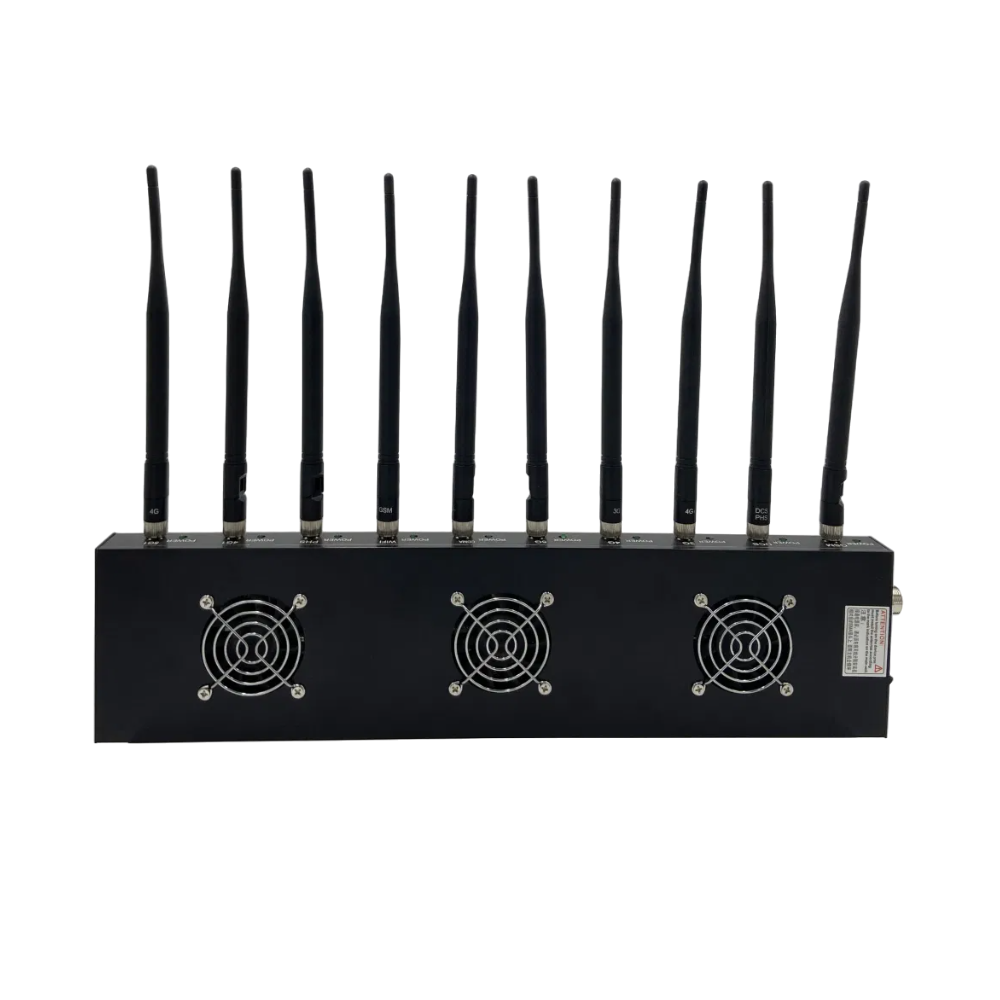
A 5G smartphone signal jammer operates by introducing controlled electromagnetic interference into the same frequency range used by mobile phones.
When activated, the jammer emits radio frequency signals that are close to—or overlap with—the frequencies used for cellular communication. These emitted signals do not carry meaningful voice or data content. Instead, they function as noise.
Because mobile communication depends on the phone detecting and locking onto a clean signal from a base station, the presence of stronger interfering signals disrupts this process.
In simple terms:
As a result, the device may display:
The phone is not damaged. It simply cannot complete the handshake required for network registration.
Wireless communication operates on signal-to-noise ratio (SNR). For a mobile device to function properly, the intended signal from the base station must be stronger and clearer than background noise.
A Audio jammer increases the noise level within the targeted frequency band. When the noise overwhelms the usable signal, the phone cannot decode valid communication instructions. Without that clarity, the connection collapses.
Importantly, the jammer does not need to overpower an entire cellular tower. It only needs to disrupt the local environment within a defined radius.
Modern mobile networks operate across multiple frequency bands. Advanced signal jammer devices are often designed to target:
By covering multiple bands simultaneously, a jammer ensures that phones cannot simply switch to an alternative frequency to regain connectivity.
Some systems are adjustable, allowing operators to select specific bands depending on their intended application. This flexibility reflects the technical sophistication of modern RF control equipment.
The effective range of a signal jammer depends on several variables:
In environments where base station signals are strong, a car remote control jammer must generate sufficient interference within its coverage area to disrupt the signal-to-noise balance. In enclosed spaces, RF reflection and absorption can influence how signals behave.
Understanding these environmental factors is crucial for responsible and predictable operation.
When a signal jammer is active in a defined area, mobile devices within range typically exhibit recognizable behaviors:
Once the jammer is turned off, phones automatically attempt to reconnect to the nearest available base station.
This temporary interruption highlights how dependent smartphones are on continuous RF connectivity.

It is important to acknowledge that signal jammers are regulated in many countries. Their use is often restricted to specific environments or authorized scenarios. Understanding the working principle of signal jammers should be approached from a technical and educational perspective.
Knowledge of how electromagnetic interference affects communication systems helps engineers, security planners, and technical professionals better understand both vulnerability and control within wireless networks.
Even for those who never deploy such devices, understanding how a signal jammer works offers valuable insight into:
In a world built on wireless connectivity, recognizing how signals can be interrupted deepens our understanding of how they function in the first place.
As discussions about wireless control and RF awareness grow, reliable technical explanations are essential. TheJammerBlocker.com provides educational insight into wireless signal jammer technology, helping readers explore how electromagnetic interference operates and how signal environments can be managed responsibly.
By focusing on technical clarity rather than sensationalism, the platform supports informed understanding of wireless systems and their limitations.
Mobile communication may feel seamless, but it depends entirely on stable radio frequency exchange. A signal jammer works by introducing controlled electromagnetic interference that disrupts this exchange, preventing mobile devices from establishing a reliable connection with base stations.
This process does not destroy devices or networks—it simply alters the signal environment enough to interrupt communication.
Understanding this principle reminds us that wireless connectivity is not magic. It is physics. And like all physical systems, it can be influenced, managed, and studied.
In an era where nearly everything relies on wireless signals, knowledge of how those signals function—and how they can be interrupted—has become part of modern technological literacy.


